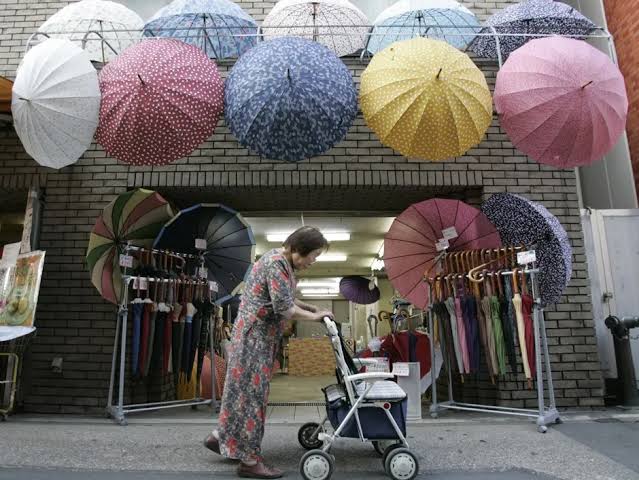

Last year, more than 18,000 people living with dementia wandered from their homes in Japan. Nearly 500 of them were later found dead.
The figures, drawn from police data, reveal a crisis deepening with each passing year. Since 2012, the number of missing elderly with dementia has doubled, laying bare the immense strain on the world’s oldest society, where over 29% of the population is aged 65 or older.
Behind the statistics are families stretched thin, a shrinking workforce, and a care system pushed to its limits. With strict immigration policies curbing the influx of foreign caregivers, Japan is turning increasingly towards technology to bridge the gap.
“The government has recognised dementia as one of the most urgent policy challenges we face,” said a Health Ministry official. The financial weight is staggering: dementia-related care costs are projected to reach 14 trillion yen ($90bn) by 2030, up from nine trillion yen in 2025.
In response, communities and companies are innovating under pressure. GPS tracking devices, often worn as pendants or shoe inserts, are now commonly used to monitor those at risk of wandering. In some towns, convenience store workers receive real-time alerts, transforming local shops into nodes of a community safety net.
Technology is also looking further ahead. Researchers at Waseda University are developing AIREC, a 150kg humanoid robot designed to assist with daily tasks such as helping a person put on socks, scramble eggs, or fold laundry. The hope is that, in time, such machines might also change diapers and prevent bedsores.
“Early detection of age-related diseases is key,” says Hidenori Fujiwara, a spokesperson for Fujitsu, which is working on motion-capture technology to help doctors identify mobility declines sooner. “If we can intervene earlier, we can help people remain active and independent longer.”
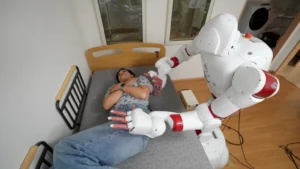
Already, simpler assistive robots are being used in care homes to lead exercises, provide companionship through music, or monitor residents overnight via sensors placed under mattresses.
But technology alone is not a silver bullet. Assistant Professor Tamon Miyake, involved in robotics development at Waseda, cautions that truly safe, interactive humanoid caregivers are still years away. “The level of precision and intelligence required will take at least five more years of development,” he says.
For now, the crisis continues to walk out the front door, a silent exodus of confused elders, and a society scrambling to bring them home safe.