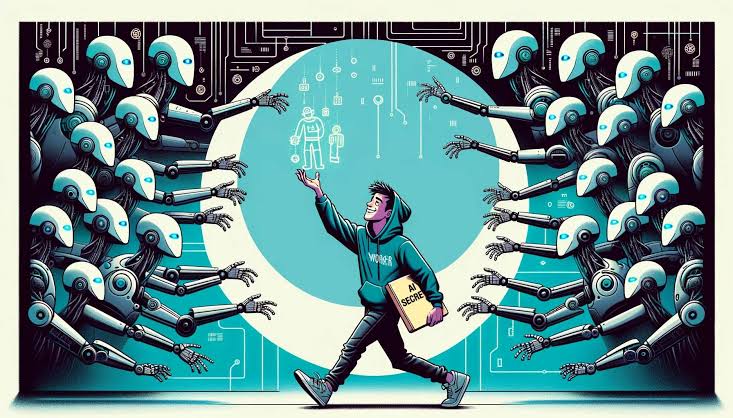

Can AI take your Job? The question should be; would you allow it?
There’s a quiet anxiety rippling across offices, studios, and classrooms. It isn’t always spoken aloud, but it hums beneath meetings, hangs over job boards, and lingers in the pauses after we ask: “Did you hear what AI can do now?”
That question is no longer hypothetical. Artificial intelligence, once confined to research labs and sci-fi novels is now a daily presence. At IBM, hundreds of HR roles have already been replaced by AI. At Microsoft and Google, over a quarter of the code is now written by machine. Writers are outsourcing first drafts and editing to AI tools. For many, this sounds less like innovation and more like obsolescence knocking on the office door.
Public skepticism is palpable. Only 23 percent of Americans surveyed believe AI will have a positive impact on jobs. That disconnect between what’s happening and what we feel prepared for is not surprising. Unlike layoffs, AI’s impact doesn’t come with a pink slip. It arrives subtly: in a better search result, an automated email, or a line of code written faster than you could manage yourself.
Still, not all jobs are at equal risk. A recent study by Anthropic, the company behind the AI assistant Claude, analyzed a million user conversations and mapped them to more than 700 occupations. They found that AI was already automating or augmenting about 25 percent of tasks across the workforce as of late 2024. For some, this meant faster productivity. For others, fewer tasks meant fewer hours or no job at all.
But the key word here is difference.
Jobs in programming and translation are being automated at an alarming rate. AI writes clean, efficient code and translates languages with stunning accuracy often without needing human input. These are the jobs where AI doesn’t just assist; it replaces.
Contrast that with educators, librarians, or social workers. Their jobs are being augmented, not overtaken. AI might help professors draft quizzes or suggest reading materials, but it doesn’t replace the nuance of teaching, mentoring, or navigating human complexity.
In economic terms, this distinction between automation and augmentation is crucial. The former depresses wages and fuels unemployment. The latter boosts productivity, especially for skilled workers, and opens up new roles, many of which we couldn’t have imagined five years ago.
In the tech sector, often considered untouchable, the ground is already shifting. Over half of the tasks in computer and math jobs are now vulnerable to AI. Ironically, the very people who built these systems are among the first to feel their disruptive potential. And while new roles such as AI ethicists and safety engineers may emerge, they don’t yet offset the wave of layoffs currently hitting the industry.
So, what do we do?
First, we acknowledge reality. Pretending AI is a passing trend is a luxury few can afford. The better question is: How do we use AI before it uses us?
Start by learning. Play with the tools. Use AI to plan your week, refine your writing, or generate creative ideas. Understand its strengths and its blind spots, especially its capacity to reflect and magnify human bias. Know which parts of your job can be automated, and which rely on distinctly human traits: empathy, ethics, intuition, and creativity.
Then, apply it. Use AI at work, not as a crutch, but as a partner. Ask it to organize your research. Use it to test your reasoning. If you’re in marketing, let it draft campaign ideas. If you’re a journalist, let it summarize background material. The goal isn’t to compete with the machine, but to work smarter because of it.
AI is a tsunami, powerful, complex, and coming in fast. But like all waves, it won’t crash into everyone the same way. It will crest gently for some, and break violently for others.
The challenge isn’t to outrun it, that’s impossible. The challenge is to rise above it. And that begins not with fear, but with awareness, adaptability, and the courage to ask: What can I do better, differently, or more humanely than a machine ever could?
– R.B
( R.Benedict is an anonymous opinion piece contributor on Jollofmash.com.ng )