

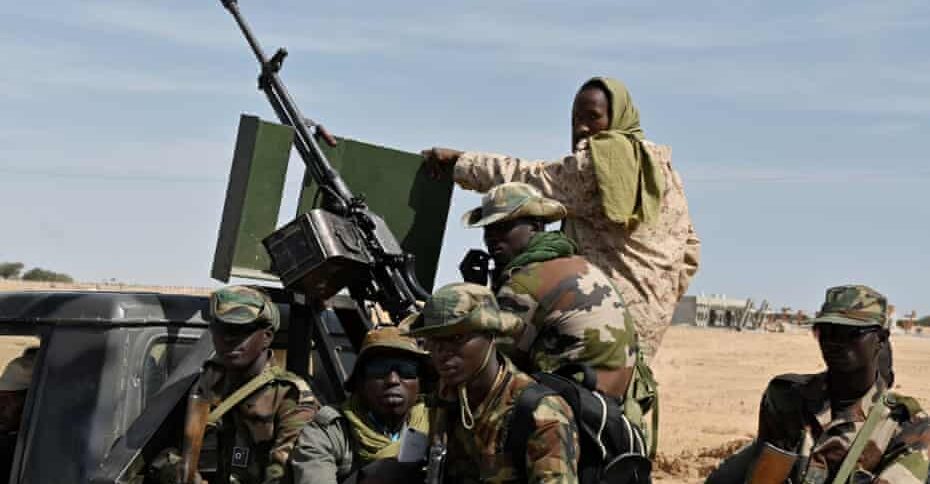

With the terrorism landscape attaining newer dimensions globally, Nigeria has risen in ranks. The Sahel country is gradually becoming one of the world’s most affected countries even as overall deaths fall to their lowest level in a decade.

According to the latest Global Terrorism Index 2026 released by the Institute for Economics and Peace, terrorism-related deaths worldwide dropped by 28 per cent in 2025. Yet beneath that headline improvement lies a more troubling reality: violence is becoming increasingly concentrated in specific regions and Nigeria is at the heart of it.
The report ranks Nigeria as the fourth most impacted country globally, behind Pakistan, Burkina Faso and Niger. The country recorded 750 terrorism-related deaths in 2025, marking a sharp 46 per cent increase from the previous year, the highest toll since 2020.
Reports say the spike is driven by persistent internal instability and the violent rivalry between extremist factions, particularly Boko Haram and Islamic State West Africa Province (ISWAP), both of which continue to terrorise communities in the country’s northeast.
But Nigeria’s surge is part of a broader and more alarming trend across Africa’s Sahel region now widely described as the “global epicentre of terrorism.”
Stretching across the southern edge of the Sahara Desert from the Atlantic Ocean to the Red Sea, the Sahel accounted for nearly half of all terrorism-related deaths worldwide for the third consecutive year. In 2025 alone, close to half of the 5,582 global fatalities occurred within this fragile belt.
The numbers tell a stark story. Since 2007, terrorism-related deaths in the Sahel have increased tenfold, transforming the region from a peripheral hotspot into the centre of global extremist violence.
“The epicentre of terrorism has shifted from the Middle East and North Africa into sub-Saharan Africa,” the report noted, underscoring a geopolitical pivot with far-reaching implications.
While countries like Mali recorded some improvement, with deaths dropping from 604 in 2024 to 341 in 2025, the overall threat in the region remains deeply entrenched. Much of the violence is attributed to extremist networks linked to the Islamic State and the al-Qaeda-affiliated Jama’at Nasr al-Islam wal Muslimin (JNIM).
The report also warns of an expanding threat footprint, with militant groups pushing further into coastal West African nations. Benin, for instance, has seen a notable rise in attacks, climbing from 26th to 19th place on the global index.
In a striking contrast, the rest of the world is experiencing a relative decline in terrorism. Total attacks globally fell by nearly 22 per cent, contributing to the overall drop in fatalities.
However, the West is facing a different kind of surge. Terrorism-related deaths in Western countries spiked by a staggering 280 per cent in 2025, albeit from a lower base, with 57 fatalities recorded. The United States alone accounted for 28 of those deaths, its highest figure since 2019.
This has been attributed not only to organised militant campaigns but to a growing wave of youth radicalisation and “lone-wolf” attacks, often fuelled by online extremism and ideological isolation.
Despite the global decline, the report warns that the gains may be fragile. Several risk factors are converging in 2026, including escalating geopolitical tensions in Iran and across South Asia, worsening economic conditions in Western nations, and the increasing use of drone technology by terrorist groups.
These evolving dynamics suggest that while terrorism may be shrinking globally, it is becoming more unpredictable and in regions like the Sahel, more deadly.











You really know how to connect with your readers.