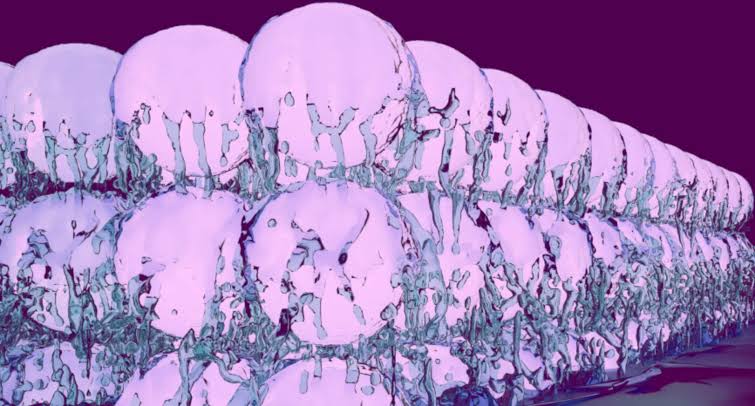

Can light become solid? Yes!
Researchers in Italy have successfully transformed light into a supersolid, a bizarre state of matter that behaves like both a solid and a liquid simultaneously.
This achievement marks the first time photons, the fundamental particles of light, have been coaxed into this exotic form.
For decades, supersolids existed only in theory. They have the rigid structure of a crystal but can flow without friction like a superfluid. “We can imagine the supersolid as a fluid composed of coherent quantum droplets periodically arranged in space,” explains Iacopo Carusotto, an atomic and optical physicist from the University of Trento.
How Do You Turn Light Into a Solid?
Since light is energy, not matter, researchers had to get creative. The team, led by scientists at Italy’s National Research Council (CNR), coupled photons with matter by shining a laser onto a gallium arsenide semiconductor.
This interaction produced polaritons—quasiparticles that blend the properties of light and matter.
As the laser filled the semiconductor, photons settled into three distinct quantum states. Once the lowest-energy state became crowded, pairs of photons spilled into adjacent states, forming a bound state in the continuum (BiC) a critical step in creating the supersolid.
The Proof Is in the Peaks
To confirm they had created a supersolid, the scientists mapped the density of the photons. What they found was unmistakable: two towering peaks separated by a central gap, a hallmark of supersolid behavior. This pattern indicated that the system had broken translational symmetry—a key feature distinguishing supersolids from ordinary matter.
Why Does This Matter?
Good question!
Studying supersolids provides a rare glimpse into the mysterious world of quantum interactions. By isolating these effects from thermal noise, researchers can better understand how fundamental particles behave and interact.
“This exotic state of condensed matter allows us to explore new physical properties and could lead to innovative light-emitting devices,”_ says Dario Gerace, a condensed matter physicist from the University of Pavia.
Beyond theoretical physics, this research could open doors to advanced photonic technologies, including next-generation lasers and quantum computing applications.
For now, the ability to “freeze” light into a supersolid pushes the boundaries of what we thought possible—turning the intangible into something both solid and fluid, and unlocking new possibilities for the future of science and technology.