
In the sun-scorched farmlands of rural India and the remote villages of Nigeria, a silent, slithering epidemic claims tens of thousands of lives each year, a toll of suffering the World Health Organization calls one of the planet’s most neglected health crises. Even urban areas and not left out.
New data reveals India, Nigeria, Brazil, and Indonesia shoulder the world’s heaviest burden of snakebite deaths, with India alone accounting for roughly half of the global fatalities: an estimated 50,000 to 58,000 lives lost annually.
A groundbreaking report by the global health research group GST has exposed a harrowing reality: 99% of healthcare workers across these four nations face critical challenges in administering life-saving antivenom.
Surveying 904 medical professionals, researchers found a lethal cocktail of poor infrastructure, scarce antivenom supplies, and insufficient training paralyzing response systems.
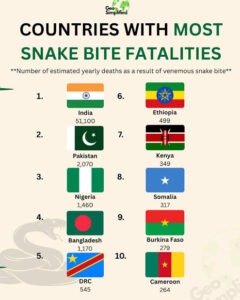
“In India, snakebites are seen as a poor person’s problem,” says Dr. Yogesh Jain, a GST member practicing in Chhattisgarh. “That’s why there isn’t enough outrage over these completely avoidable deaths. When it comes to treating snakebites, every second counts.”
The venom of a viper or cobra can invade the bloodstream within minutes, attacking nerves, tissues, and organs. Delays in treatment frequently lead to amputations, lifelong disability, or death. Yet in vast rural stretches, bad roads, distant hospitals, and a lack of ambulines turn emergencies into tragedies. In one gut-wrenching case last September, a pregnant woman in Gujarat died after her family carried her for 5 kilometers in a cloth sling because no vehicle could reach their village.
Even when antivenom is available, many health workers, often undertrained and under-equipped, fear administering it due to potential adverse reactions. “Many centres aren’t equipped to manage the side-effects,” explains Dr. Jain.
Compounding the crisis, India’s antivenom only neutralizes the “Big Four” deadly snakes, leaving victims of other species vulnerable, while in many regions, traditional healers remain the first resort, costing precious time.
In 2024, India launched a National Action Plan to halve snakebite deaths by 2030 through better surveillance, antivenom access, and training. Similar systemic gaps plague Nigeria and other affected countries, where rural poverty and healthcare inequity amplify the deadliness of each bite.
“People working in farms, including tribal communities, remain most vulnerable,” says Dr. Jain. With over 5.4 million global snakebites annually and more than 100,000 deaths, experts warn that without urgent, coordinated action, this overlooked plague will continue to prey on the world’s poorest and most forgotten populations.