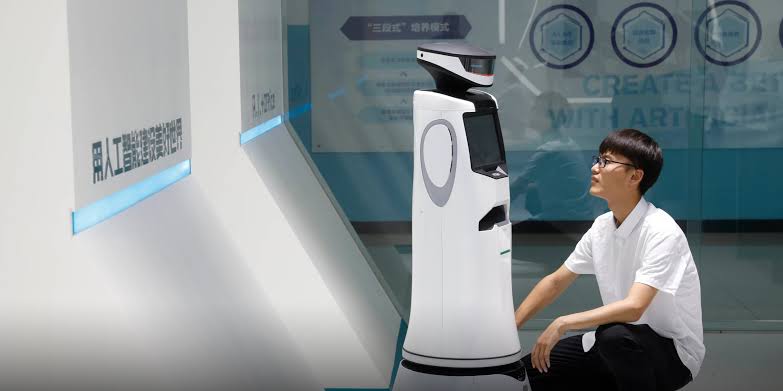

Artificial intelligence has become the new ‘piece de resistance’ for the world powers. Interestingly too, China has put itself in a lone race to outwit others in Ai dominance.
This country is making an audacious push to establish itself as a tech superpower by 2030. China’s rapid advances have drawn both admiration and apprehension, as six homegrown AI firms: DeepSeek, Unitree Robotics, Deep Robotics, BrainCo, Game Science, and Manycore Tech—have emerged as major players. Dubbed “China’s six little dragons” by the internet, these companies are blazing a trail in AI research, robotics, and computing.
Yet, as China flexes its AI muscles, concerns are mounting over what this technological boom means for data privacy. The Chinese government’s deep integration with AI has led to questions about how much it is learning not just about its own citizens but about users worldwide. The vast scale of data collection in China, with nearly a billion mobile users compared to just over 400 million in the U.S., gives Beijing an undeniable advantage in training its AI models.
This edge, however, is also a source of global unease. Many Western analysts believe Chinese tech firms operate under a legal framework that could compel them to share data with the Communist Party. Apps like DeepSeek, RedNote, and TikTok have faced accusations of funneling user information to Beijing, a claim that has fueled regulatory crackdowns abroad. Washington, citing security concerns, recently moved to ban TikTok, reflecting broader fears of China’s expanding digital reach.
Chinese firms, including ByteDance, TikTok’s parent company, insist that their operations remain independent and that data privacy laws protect their users. But geopolitical tensions continue to shape the narrative. The U.S. and its allies worry that China’s AI-powered surveillance capabilities could be leveraged for both domestic control and international influence.
Race to Burst?
The AI arms race has also unleashed an investment frenzy. China now has over 4,500 companies developing AI solutions, and the competition for funding is fierce. Schools in Beijing are set to introduce AI courses for young students this year, while universities have expanded their AI programs to cultivate the next generation of engineers and researchers.
President Xi Jinping has placed AI at the center of China’s long-term economic strategy, seeing it as a crucial driver of growth amid trade tensions with the U.S. Since 2017, the Communist Party has championed AI as “the main driving force” of national progress, and that vision is now being backed with serious capital.
Over the next 15 years, Beijing plans to inject 10 trillion yuan ($1.4 trillion) into advanced technology, with AI receiving significant government support.
The latest boost came during China’s annual political gathering, reinforcing the country’s determination to outpace Washington in AI supremacy. This follows the January launch of a 60-billion-yuan AI investment fund, a move that coincided with fresh U.S. export restrictions on advanced semiconductor chips—key components for AI development.
Yet, if the U.S. hoped these restrictions would slow China down, the rise of DeepSeek suggests otherwise. The Chinese chatbot, which made headlines in January, demonstrated that Chinese companies are capable of innovating despite trade barriers. Silicon Valley’s surprise at China’s rapid progress reveals a shifting balance of power in the AI world.
At the heart of China’s AI success is its vast talent pool. In 2020 alone, the country produced more than 3.5 million graduates in science, technology, engineering, and mathematics (STEM)—more than any other nation. This deep reservoir of skilled professionals provides China with the intellectual firepower needed to drive its AI ambitions forward.
A Subtle Economic Transition
Beijing is eager to harness this expertise, with Xi Jinping calling for a national effort to strengthen education, science, and talent development. For China, AI is not just an economic asset but a strategic necessity in the global technology race.
Decades after opening its economy to the world, China has transitioned from a manufacturing giant to a formidable player in advanced technology. Abbott Lyu, vice-president of Shanghai-based Whalesbot, believes the country’s AI rise is the result of years of talent accumulation. “In this era of AI, we have many, many engineers, and they are hardworking,” he says.
The next decade will determine whether its AI ambitions translate into global leadership or deepen the fractures in an already divided tech landscape. Either way, the rise of China’s “little dragons” is reshaping the future of artificial intelligence.