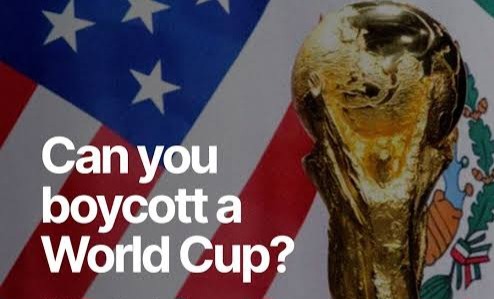

In a powerful opinion article published on Al Jazeera, columnist Tafi Mhaka argues that African nations must stage a coordinated boycott of the 2026 FIFA World Cup, hosted primarily by the United States.
Mhaka draws a direct parallel to the 1976 African boycott of the Montreal Olympics, which protested New Zealand’s sporting ties with apartheid South Africa. He contends that participating in a tournament hosted by the US would legitimize Washington’s unwavering support for Israel’s military campaign in Gaza, which he characterizes as a genocide.
The article notes that the call for action follows mounting political pressure in Europe, where British MPs have tabled a motion urging FIFA to consider excluding the US, and figures like a Dutch broadcaster and a French parliamentarian have backed petitions or warned against participation. While this scrutiny has focused on US domestic issues under President Donald Trump, such as immigration crackdowns and civil liberties concerns, Mhaka asserts that these, while serious, are eclipsed by the gravity of US foreign policy and its role in enabling the destruction in Gaza.
Mhaka details the scale of the devastation in Gaza since October 7, 2023, citing over 72,000 Palestinians killed, the vast majority of civilian infrastructure destroyed or damaged, and nearly 90 percent of the population displaced. He emphasizes that the United States has been Israel’s most critical ally, providing billions in annual military assistance and diplomatic cover at the United Nations, thereby directly financing and shaping the ongoing military operations which he describes as a grave assault with profound historical resonance for Africa.
This historical resonance is anchored in the memory of apartheid. The author evokes the 1976 Soweto Uprising, where police killed hundreds of schoolchildren, including 15-year-old Hastings Ndlovu. He contrasts this tragedy with the subsequent tour of apartheid South Africa by the New Zealand rugby team, which sparked outrage and led 22 African nations to withdraw from the Montreal Olympics. These nations sacrificed their athletes’ Olympic dreams to deny comfort and respectability to the racist regime, a defining lesson in the power and cost of collective political refusal.
The plight of Palestinian children, such as seven-year-old Sidra Hassouna who was killed in an air strike in Rafah, mirrors the suffering of Soweto’s youth. Mhaka argues that unlike the apartheid era, Israel’s destruction of Gaza is being broadcast in real-time, making the world a direct witness to what he calls childhoods erased by bombardment. The US, by continuing to supply weapons, becomes an active participant in this tragedy, making the 2026 World Cup a stage for legitimizing US policy.
Mhaka in his poser asks whether football can proceed as a celebration of sport while the host nation sustains mass civilian destruction abroad. He believes African political memory understands these stakes. A coordinated boycott, he argues, would require unified action from the nine qualified African teams, including Morocco, Senegal, and South Africa supported by the African Union and the Confederation of African Football.
The consequences of such a boycott would be significant, stripping the tournament of its claim to global inclusivity and forcing corporate sponsors to confront uncomfortable questions. More importantly, it would shift international attention, much like the 1976 boycott did, by removing the comfort of pretending injustice does not exist. It would accelerate the isolation of those complicit in the violence.
Mhaka criticizes FIFA’s political contradictions, pointing to its president Gianni Infantino awarding Donald Trump a “peace prize” at the World Cup draw, an act that extends symbolic legitimacy to a leader overseeing mass civilian death. In this context, nonparticipation becomes a critical moral position that challenges US support for the military onslaught and honors the memory of children like Hastings and Sidra.
The author concludes by framing the boycott as a historical imperative. Africa’s stand in 1976 reshaped international resistance to apartheid, and a comparable decision in 2026 could strengthen opposition to contemporary systems of domination. If African teams compete as if nothing is happening in Gaza, their involvement risks legitimizing colonial power structures.
“Football cannot be played on the graves of Palestinian martyrs,” he writes, delivering a forceful call for the continent to boycott the 2026 World Cup.
Read full opinion piece HERE

Mhaka, a social and political commentator, has a BA Honours degree from the University of Cape Town