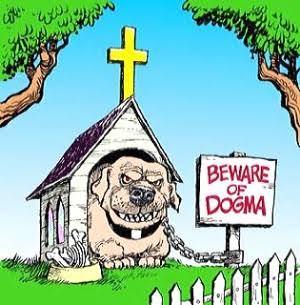

Carl Trueman’s essay “Christianity is Nothing without Dogma” takes a hard look at the struggles of mainline churches and the choices that, in his view, have hastened their decline. He opens with the Church in Wales’ appointment of Cherry Vann as its new archbishop, the first woman, and the first openly gay woman, to hold the role.

For many, this was a milestone of inclusivity. Yet Trueman points out the irony: despite these symbolic gestures, congregations remain small, aging, and unsustainable. In his assessment, churches that attempt to gain relevance by conforming to contemporary cultural tastes are only accelerating their own irrelevance.
In contrast to this trend, Trueman highlights a call to renewal issued by Sarah Coakley, former Norris-Hulse Professor of Divinity at Cambridge.
Speaking to a group of parish priests and theologians, Coakley urged churches to rediscover the power of “serious theology” rooted in dogma, worship, and the transcendent truths of Christianity. Her challenge to move beyond identity politics and shallow sentiment resonated with Trueman as a needed corrective to the dilution of Christian teaching.
To reinforce his point, Trueman turns to one of his intellectual heroes, John Henry Newman. Despite being Protestant, he admires Newman’s conviction that Christianity is meaningless without dogma.
For Newman, religion was not a matter of sentiment or cultural fashion but the dogmatic expression of supernatural truth. Trueman borrows Newman’s own words, calling any attempt to reduce Christianity to mere community feeling or political utility “a dream and a mockery.”
The strength of Trueman’s essay lies in its clarity and force. His central argument is unambiguous: if Christianity abandons dogma, it ceases to be Christianity. He skillfully situates the present crisis within a historical and theological tradition, drawing a straight line from Newman’s nineteenth-century warnings to Coakley’s twenty-first-century exhortations. His writing brims with urgency, reminding readers that churches cannot afford to trivialize faith if they wish to remain relevant.
Yet the piece is not without weaknesses. Trueman’s sharp language, including his quip that “there is no cure for stupid,” risks undermining the seriousness of his case. His critique of inclusivity as a “suicide note” also oversimplifies the complex sociological and cultural forces behind church decline. Moreover, while he is quick to prescribe dogma as the cure, he does not address how doctrinal faith can coexist with pastoral sensitivity and inclusivity in today’s pluralistic world.
Ultimately, Trueman’s essay stands as both a warning and a challenge. It is a warning against hollowing out Christianity to fit cultural trends, and a challenge to rediscover the richness of theology and worship rooted in dogma.
Even if one disagrees with his dismissive tone, his call to re-center Christianity on its doctrinal core is a timely reminder for a faith tradition navigating the turbulent waters of modern culture.