

Katsina State has emerged as a continental front-runner in climate governance, securing 7th place worldwide among 275 subnational governments across 33 African countries for its bold interventions in addressing the climate crisis.
The recognition, conferred by Green Climate International (GCI), a Canada-based climate support organisation, was presented to Governor Dikko Umaru Radda in honour of the state’s ambitious environmental strategy.
GCI described the accolade as a testament to Katsina’s “visionary leadership and demonstrable excellence in addressing the climate crisis.”
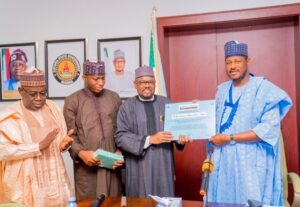
The award follows Katsina’s active participation at the Second Africa Climate Summit (ACS2), where the state showcased a portfolio of climate-smart interventions designed to reduce emissions, restore degraded lands, and build resilience to extreme weather events. GCI’s citation praised Katsina’s approach as “a model of national excellence and a guiding light for West Africa.”
The agenda defines a pathway to low-carbon development, spanning renewable energy, transport, agriculture, and urban planning.
Among the flagship policies is a transition to electric vehicles, aimed at cutting emissions from transport while advancing cleaner mobility options across the state.
The plan also highlights a commitment to afforestation and climate-smart agriculture. These initiatives are designed not only to reverse deforestation and expand tree cover but also to equip farmers with sustainable techniques that improve yields without depleting the environment. By tackling land degradation, the state seeks to combine food security with ecological restoration.
Katsina’s strategy also pays close attention to its rapidly growing urban centres, with a focus on resilient urban renewal projects.
These are intended to help towns and cities withstand climate shocks such as flooding, heatwaves, and infrastructure strain. In practice, this means rethinking drainage systems, greening public spaces, and investing in sustainable housing solutions.
So far, Katsina has completed 14 development interventions and outlined 16 new projects ready for collaboration with international partners and multilateral climate finance institutions. This blend of practical delivery and forward planning helped set its submission apart on the global stage.
By achieving this recognition, Katsina joins a select group of subnational governments proving that climate leadership is not only the domain of nation-states.
Other governments that received recognition from GCI include Addis Ababa in Ethiopia for its sustainable transport system, Cape Coast in Ghana for coastal resilience initiatives, and Nairobi County in Kenya for urban greening and waste-to-energy projects. Together, these efforts reflect how local innovation can shape the continent’s response to the climate crisis.