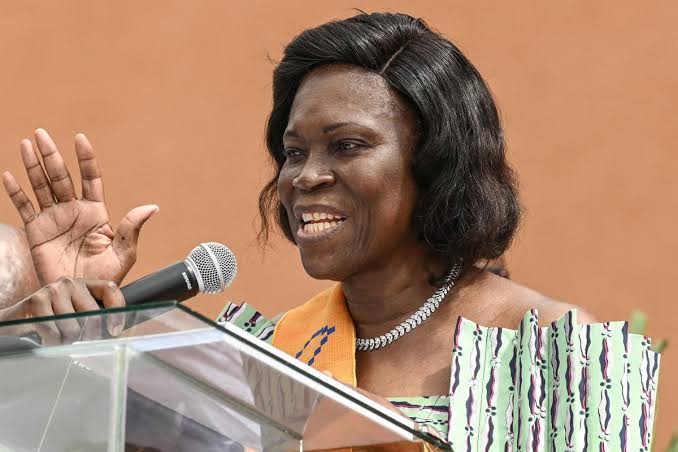

Simone Gbagbo has never been a stranger to controversy, and now she is back in the spotlight with the most audacious move of her career, running for the presidency of Ivory Coast.
At 76, the former first lady, once described as the “iron lady” of Ivorian politics, has been cleared to contest in October’s elections. For her supporters, it is a moment of redemption; for her critics, it is an unsettling comeback. But for Gbagbo herself, it is a chance to “modernise” Ivory Coast and prove that she can lead a nation in her own right.
Her journey to this point has been anything but ordinary. Just over a decade ago, she was hiding in a bunker, attempting to evade arrest after her husband Laurent Gbagbo’s refusal to concede defeat in the 2010 election triggered a civil conflict.
Once feared as the power behind her husband’s throne, Simone was convicted of crimes connected to that turbulent period. She has since endured prison time, divorce, and political exile, yet she now stands before Ivorians not as an embattled spouse, but as a candidate for the highest office.
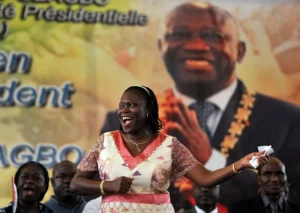
During her time as first lady between 2000 and 2011, Simone Gbagbo cultivated a reputation for toughness that earned her both respect and fear.
Her admirers called her “maman,” a maternal figure in politics, while opponents saw her as uncompromising, calculating, and even ruthless.
She herself once declared to L’Express magazine: “All the ministers respect me. And they often consider me above them.” It was a statement that summed up her political persona; bold, unapologetic, and impossible to ignore.
Her roots in activism run deep. With degrees in history and linguistics, Simone began her career as a teacher and quickly became a formidable voice in Ivory Coast’s educators’ unions. It was in that same trade union movement that she met Laurent in 1973.
Together they challenged the autocratic rule of President Félix Houphouët-Boigny, co-founding the Ivorian Popular Front (FPI) in 1982. Their partnership was as much political as it was personal, forged in years of struggle against repression.
Their resilience was tested repeatedly. When Laurent fled into exile in France after harassment from state security forces, Simone was left to raise their twin daughters alone. Yet she never abandoned the cause. By the time Laurent returned six years later, the Gbagbos were seasoned opposition figures ready to seize the moment when multi-party democracy was finally permitted in 1990. Though Laurent lost that year’s presidential race, the couple began building a formidable political dynasty.
Observers often remarked on their contrasting styles. Le Monde described Laurent as having “the good-natured gab” while Simone wielded “the uncompromising discourse.” Opposition paper Le Patriote was harsher, painting him as “expansive, warm, and devious” while she was “enigmatic, cold, and secretive.” Whether admired or despised, Simone’s influence was undeniable. In 1995 she secured her own seat in the National Assembly, cementing her as more than just her husband’s political partner.
When Laurent finally captured the presidency in 2000, Simone’s power only deepened. But their victory came with contradictions. Once advocates for democracy, the Gbagbos presided over a regime accused of silencing dissent and exploiting the divisive doctrine of Ivoirité, a nationalist ideology that inflamed tensions and fueled conflict. Simone, many believe, exerted immense sway over the security forces, whose actions during the turbulent years left scars that still shape Ivory Coast’s political landscape.
Now, with Laurent sidelined and the country still grappling with its history, Simone Gbagbo is attempting the ultimate political reinvention.
Her critics argue her past disqualifies her from leading a reconciled nation, while her supporters see her resilience and experience as proof she can rise again.
As election day approaches, the “iron lady” faces perhaps the toughest campaign of her life, not just to win power, but to convince Ivorians that she is no longer the shadow behind the throne, but a leader who can command the stage on her own.