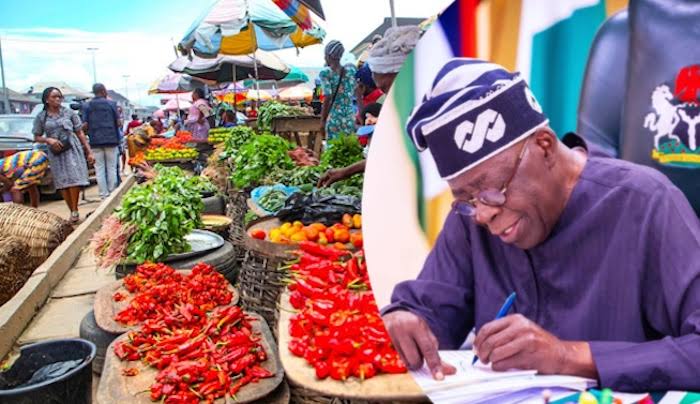

President Bola Tinubu has ordered a Federal Executive Council (FEC) committee to urgently fast-track measures aimed at curbing the rising cost of food in Nigeria, as households struggle under worsening food insecurity.
The Minister of State for Agriculture and Food Security, Senator Aliyu Sabi Abdullahi, revealed the directive on Wednesday in Abuja at a capacity-building workshop for Senate correspondents.
He said the President’s immediate focus is ensuring the safe passage of farm produce across major transport corridors, a move expected to ease the crushing logistics costs caused by insecurity and high fuel prices.
“The President has given a matching order with a Federal Executive Council committee already handling it on how we are going to promote safe passage of agricultural foods and commodities across our various routes in the country,” Abdullahi explained.
Food inflation has spiked dramatically in Africa’s most populous nation since the removal of fuel subsidies, compounded by soaring transport expenses and frequent attacks on highways that disrupt the flow of goods.
For many Nigerians, the consequences have been devastating: staples such as rice, beans, and maize have doubled or tripled in price within months.
However, Abdullahi linked the safe passage initiative to Tinubu’s broader push for food sovereignty, a strategy not only to guarantee availability but also affordability, accessibility, and long-term nutritional security.
“The vision is for food security that is sustainable and beneficial to every household,” he noted.
To complement this, the government is preparing to roll out a Farmer Soil Health Scheme designed to improve crop yields, alongside a cooperative reform initiative aimed at mobilising rural resources and empowering local farmers.
“Mr. President has shown tremendous interest in the cooperative sector as a veritable tool for resource mobilisation, for economic activity generation, and to improve the livelihood of members,” Abdullahi said.
The new plan has the potential to ease pressure on food supply chains if executed with discipline. Yet there is caution that Nigeria’s longstanding challenges—poor storage systems, weak transport infrastructure, and rising insecurity—could blunt the impact of reforms unless addressed in parallel.