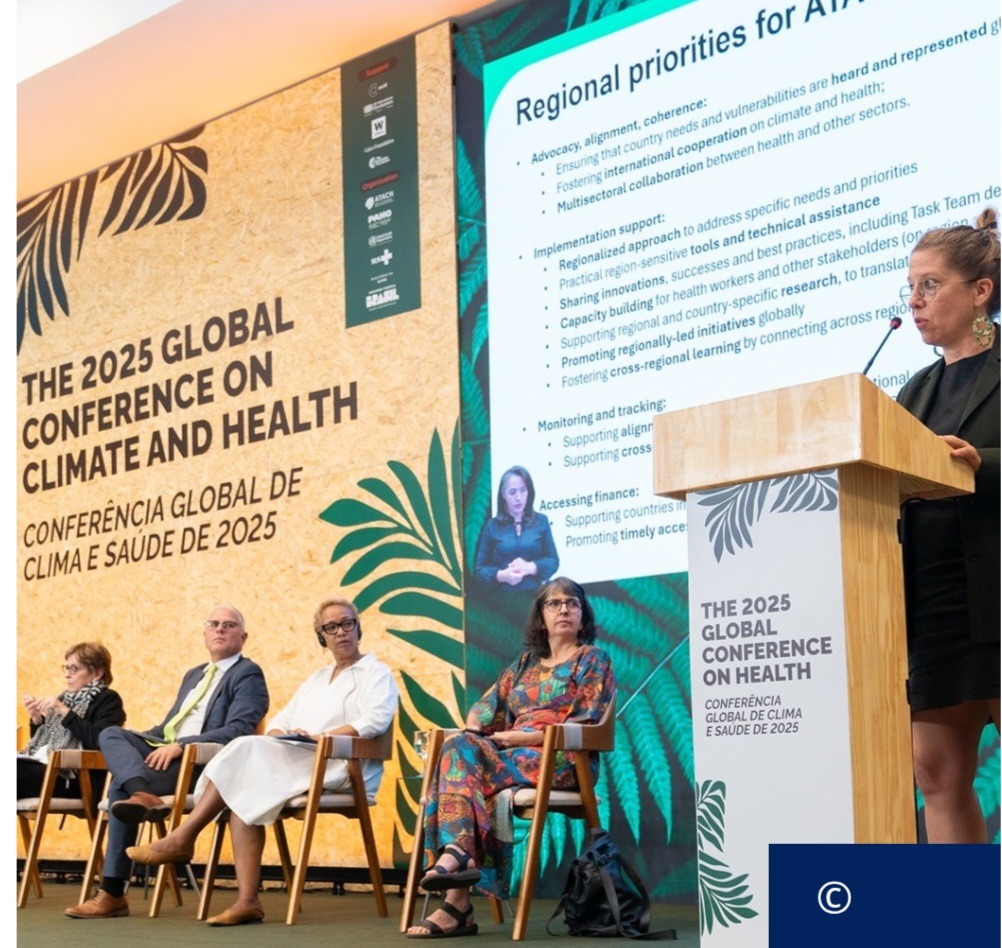

Leaders in health and climate worldwide who were in Brasília from July 29 to 31 for the Fifth Global Conference on Climate and Health have rededicated themselves to shaping the future of climate and health policy ahead of COP30 fixed for November.
Representatives from ministries of health, philanthropic organizations, nongovernmental organizations, and climate-health experts came together to push forward practical policies that merge political will with urgent environmental action.
“This conference can be a springboard to build healthier, more resilient, and more equitable societies,” said Dr. Tedros Adhanom Ghebreyesus, Director-General of the World Health Organization, in his opening video message.
Participants worked collectively to strengthen political commitment, advance practical solutions, and embed health as a non-negotiable priority in climate discourse. The gathering also sought to bridge health and climate agendas, elevate Indigenous leadership, and coordinate a unified global response.
The message pointed to the fact that: political leadership must be matched by decisive public action. “It’s not about creating a new way, it is about walking differently,” said Brazil’s Minister of the Environment and Climate Change, Marina Silva.
Two main agendas dominated the conference — developing the Belém Health Action Plan to be launched at COP30, and convening the second in-person meeting of the Alliance for Transformative Action on Climate and Health (ATACH).
“The best thing we can do to fight inequalities in climate and health is to fight for the Belém Health Action Plan,” said Dr. Maria Neira, outgoing Director of the Department of Environment, Climate Change and Health. “ATACH will be the platform for facilitation, implementation, and monitoring the results to ensure action.”
Key outcomes included:
– The announcement of a dedicated Health Day at the 2025 UN Climate Change Conference in Belém, Brazil (COP30).
– Agreement on the Belém Health Action Plan, centred on three strategic lines: health surveillance and monitoring; evidence-based policy strategy and capacity building; and innovation and production.
– Presentation of a global stocktake of climate-resilient health system action by ATACH.
– Renewed commitment to elevate Indigenous voices in climate and health policymaking.
Throughout the event, Ideas Labs showcased innovative initiatives, fostered interdisciplinary dialogue, amplified underrepresented voices, and inspired both local and global climate-health action.
As an official pre-COP30 event, the conference higglighted the political and moral responsibility of leaders to put people at the centre of climate negotiations.
Speakers from all regions stressed that Indigenous perspectives must not be sidelined if humanity’s health and the planet’s survival are to remain intertwined priorities.