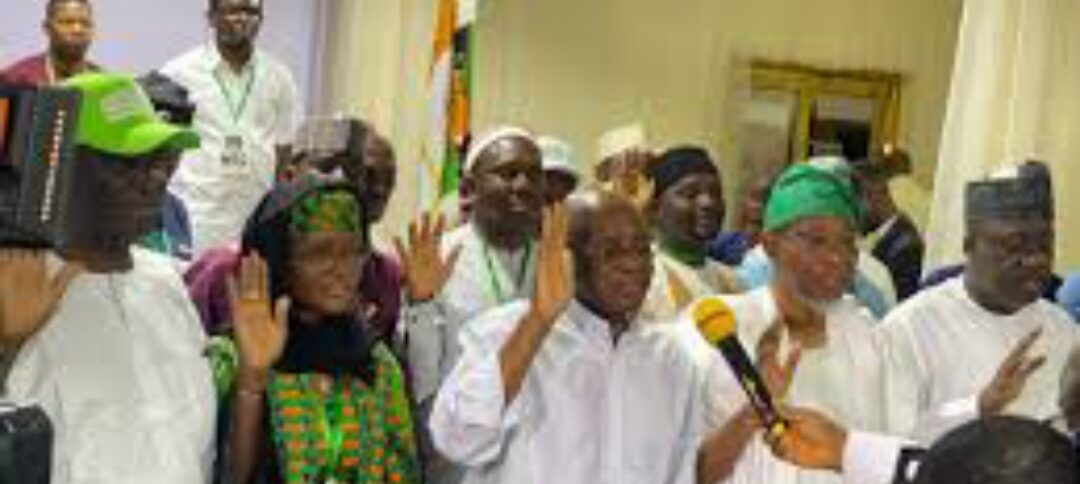

While Nigeria grapples with economic hardship, growing insecurity, and a disillusioned population, many of its top politicians seem fixated on 2027.
Nowhere is this more evident than within the African Democratic Congress (ADC), where signs of division and internal scheming have cast doubt on the credibility and future of the much-hyped opposition coalition.
Once considered a promising third force, the ADC is now gripped by a silent storm. Deep fissures have emerged, reportedly driven by former Vice President Atiku Abubakar’s alleged attempts to influence the party’s structure in anticipation of a 2027 presidential run. While not yet official, Atiku’s shadow looms large over the party, with reports suggesting that many ADC chapters, national organs, and state bodies now lean toward his camp.
Meanwhile, Peter Obi, the 2023 Labour Party candidate and popular figure among Nigeria’s youth, is said to be struggling to cement his relevance within the coalition. His supporters, known as the Obidient Movement, have expressed frustration over their exclusion from key decisions within the ADC framework. In a leaked internal memo dated July 29, 2025, the group accused ADC leadership of marginalisation and warned that the lack of inclusion could derail the coalition’s unity.
One senior coalition member, speaking on condition of anonymity, painted a picture of a lopsided power dynamic: “Over 70% of the ADC’s key structures are already in Atiku’s pocket. His allies joined early, brought money, and took over decision-making platforms. Obi, Amaechi, and others appear sidelined, even if they’re technically still part of the alliance.”
Such claims were further bolstered by accusations from ADC’s 2023 presidential candidate, Dumebi Kachikwu, who alleged that the interim party leadership, led by David Mark, is quietly pushing an Atiku candidacy under the radar.
Despite these growing claims, the ADC’s interim National Publicity Secretary, Bolaji Abdullahi, maintains that the party remains united and committed to dislodging President Bola Tinubu and the APC in 2027. He insists no candidate has been imposed and that all aspirants will enjoy a level playing field.
But the optics tell a different story. Many within Obi’s camp worry that the deck is already being stacked in Atiku’s favour. Out of over 25 members in the current ADC National Working Committee (NWC), Obi’s input reportedly led to only one appointment , the National Organising Secretary. “That’s hardly fair representation,” a source close to the Labour leader lamented.
In a bid to calm nerves, the Chairman of ADC’s Board of Trustees, Ibrahim Mani, downplayed fears of internal discord. “There’s no real division,” he told The PUNCH. “But we understand the concerns. Nigerians are tired of governance failures and want hope. The APC has put the country in campaign mode again, even though governance should be the focus. So, understandably, there’s anxiety.”
Political observers, however, are less convinced. To them, the ADC’s ongoing internal power play suggests a fragile coalition that may unravel before 2027. The ruling APC, for its part, has dismissed the opposition’s efforts. Bala Ibrahim, Director of Publicity for the APC, described the ADC coalition as “a marriage of strange bedfellows driven by anger, not strategy.”
“This is a confused coalition. They have no unity of purpose,” he said. “They want to remove Tinubu, but with what plan? With this kind of internal drama, they’re destined to fail.”
As the dust continues to swirl within the ADC, one thing is clear: the party’s struggle to manage ambition, power, and trust may prove to be its undoing. While the coalition claims to be Nigeria’s hope for change, its inability to maintain internal coherence raises serious doubts. The race for 2027 has already begun but for the ADC, it’s unclear if the starting blocks are even in place.