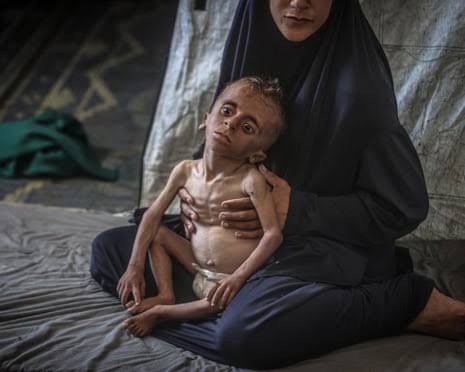

The war in Gaza has taken many lives, shattered homes, and destroyed vital infrastructure but perhaps its most haunting consequence is the slow, agonizing hunger consuming the region’s children.
The image of war is no longer confined to airstrikes and rubble. Now, it’s a skeletal child staring blankly into the distance, their tiny frame fading with every passing day of neglect.
The United Nations Relief and Works Agency (UNRWA) has raised the alarm: one in every five children in Gaza City is malnourished, and the number is growing by the day. In some areas, the situation is rapidly spiraling toward famine, according to more than 100 international humanitarian organisations and human rights bodies. They have jointly warned that mass starvation is not just a possibility, it is already unfolding.
UNRWA’s Commissioner-General, Philippe Lazzarini painted a chilling picture of Gaza’s current reality. Echoing the words of a colleague on the ground, he described the residents as “walking corpses,” stuck in a limbo between life and death.
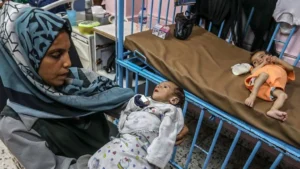
The children his team encounters are “emaciated, weak, and at high risk of dying” if immediate and sustained humanitarian assistance is not delivered.
“The aid reaching Gaza is a mere trickle,” Lazzarini warned. “And the hunger crisis has never been this dire.”
He added that even UNRWA workers themselves are fainting on duty due to starvation, signalling the collapse of the very system meant to deliver aid. “When caretakers cannot find enough to eat,” he said, “the entire humanitarian system is collapsing.”
This desperation is echoed in the voices of Gaza’s people. Hanaa Almadhoun, a 40-year-old mother of three, spoke to the BBC over WhatsApp, detailing how food has become a luxury. Even when local markets have supplies, prices are so inflated that ordinary people can’t afford basic necessities. “We’ve sold gold and personal belongings just to buy flour,” she said. “Every new day brings a new challenge. We just look for something edible.”
The choice between starvation and safety is one many now face.
Najah, a 19-year-old widow sheltering in a Gaza hospital, is afraid to walk to a food distribution site for fear of being shot. “I hope they bring us something to eat and drink,” she pleaded. “We die of hunger with nothing to eat or drink. We live in tents. We are finished off.”
Across Gaza, hunger is no longer an unfortunate consequence of conflict, it’s a weapon of war. And children are the most vulnerable targets.
UNRWA is now urging the Israeli authorities to allow unrestricted and uninterrupted access to humanitarian partners, so they can deliver food, water, and medical aid before the crisis deepens further.
But time is running out.
The international community, so far, has been largely paralyzed, caught between politics and paralysis. Yet the humanitarian cost of inaction grows by the minute. Gaza’s children, whose bellies gnaw from hunger, are not just statistics in a conflict. They are the future fading before our eyes.