

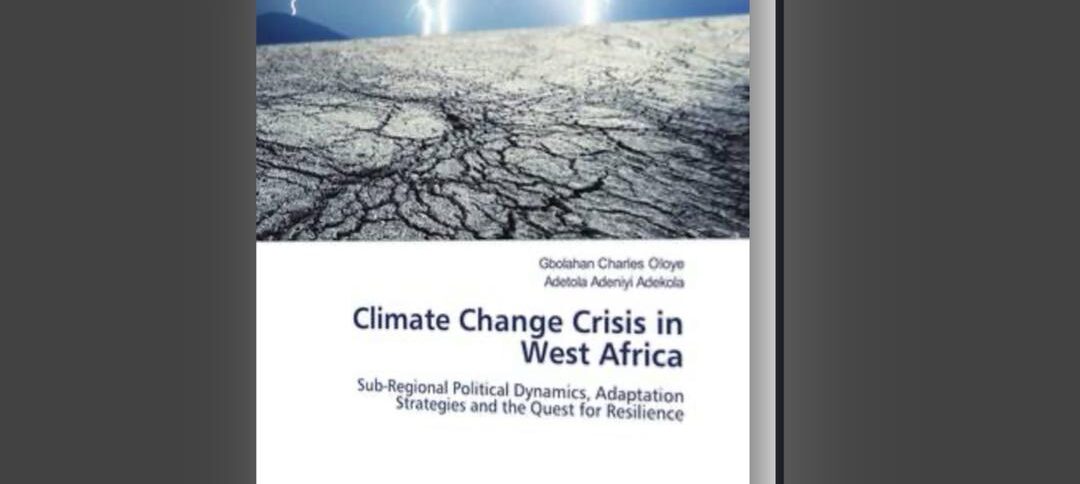

In an era where climate change dominates global headlines, Climate Change Crisis in West Africa: Sub-Regional Political Dynamics, Adaptation Strategies, and the Quest for Resilience takes off as timely and necessary.
It’s a joint work by Gbolahan Charles Oloye and Adetola Adekola
Judging from its topic, this book promises an ambitious yet grounded exploration of the West African climate emergency, an issue often underrepresented in mainstream climate discourse.
At first glance, the synopsis strikes a careful balance between academic rigour and practical urgency. It signals a wide-ranging analysis that goes beyond mere statistics or generalised narratives about rising temperatures and natural disasters. Instead, it zeroes in on the layered intersection of environmental stress, governance challenges, and socio-economic realities in the West African region marked by both acute vulnerability and remarkable resilience.
What sets this work apart is its multidisciplinary approach. That doesn’t merely document climate impacts; it frames them within the broader context of political governance, regional cooperation, and grassroots agency. Terms like “livelihood theory,” “vulnerability frameworks,” and “political ecology” suggest that readers can expect a theoretically robust analysis backed by empirical depth. This is critical in a region where climate change is as much a political and economic crisis as it is an environmental one.
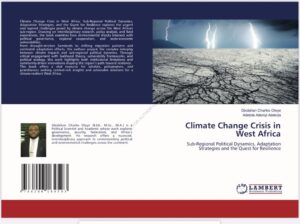
The book’s scope extends beyond governmental policy to include “lived experiences” and “community-driven innovations.” This promises a more human-centred narrative that is enriched by case studies, fieldwork and first-person accounts, which could lend the book both academic gravitas and emotional resonance.
Particularly compelling is the mention of “contested adaptation efforts.” This hints at a candid exploration of failures and disputes within adaptation policies, something many climate texts gloss over in favour of optimistic rhetoric.
This book suggests that the authors are not afraid to critique institutional shortcomings, while also acknowledging grassroots ingenuity.
While not reducing the communities to passive victims, it highlights agency and creativity, from the women-led agroforestry cooperatives in Mali to youth-led climate clubs in Togo. These grassroots initiatives reveal that resilience is not imposed from above but cultivated from below.
In terms of audience, the book is an essential read for “scholars, policymakers, and practitioners.” However, given its accessible yet scholarly tone, it may also attract concerned citizens and students eager to understand how climate change is reshaping one of Africa’s most dynamic regions.
Ultimately, the book does not claim to have all the answers. Instead, it offers a scaffolding for deeper inquiry, richer engagement, and more equitable adaptation. In framing climate resilience as both a technical and political endeavour, it challenges West African leaders to confront uncomfortable truths about governance, equity, and urgency.
A standout theme is the call for locally led adaptation. Rather than imposing global blueprints, the book advocates for bottom-up resilience strategies that reflect the lived realities of those most affected. It’s a persuasive argument that echoes global shifts toward community-based adaptation and ecosystem-based approaches.
Climate Change Crisis in West Africa is a remarkable achievement, both in depth and clarity. It traverses disciplines without losing coherence, captures nuance without sacrificing accessibility, and confronts difficult questions with intellectual honesty. For scholars of governance and climate adaptation, this book offers both theoretical depth and actionable insights. For policymakers, it’s a sobering reminder of what’s at stake. And for West African citizens, it is a validation of their daily struggles and their enduring resilience.
This work serves as a compass, pointing toward a more integrated, just, and responsive West Africa. Resilience, it reminds us, is not a product; it is a process, shaped by the decisions we make and the communities we empower.
You can grab a copy here
Reviewed by Jerry Efoma
Head of Station,
Empire Radio,
Ondo-State, Nigeria.










Proud to share our latest work with you all! This book is more than pages, it’s a journey into Climate Change Crisis in West Africa. Grateful for the support, and I hope it sparks thought, conversation, and change.
Great work , well researched and thoroughly done. It blends multiple topics with salient issues of climate change. A great read.
This book was intelligently written, and it’s clear that the research was done thoroughly and accurately. A truly thoughtful and well-executed work.
This book was intelligently written, and it’s clear that the research was done thoroughly and accurately. A truly thoughtful and well-executed work.
Great research work. God bless you.
This book was intelligently written, and it’s clear that the research was done thoroughly and accurately. A truly thoughtful and well-executed work.”
Great article
I found this book very informative, and it did a critical work on climate change in West Africa. I recommend this book for everyone
I found this book very informative, and it did a critical work on climate change in West Africa. I recommend this book for everyone.
Good job,more blessings
Educative and indepth.Good job on this.
This book is simultaneously timely and necessary. As West Africa grapples with the harsh realities of climate change, it is crucial to garner a robust understanding of the interplay between political dynamics and local adaptation strategies. It will serve as a powerful resource for policymakers, researchers, and advocates working toward a resilient sub-region.
This is a thorough work, that blends multiple topics and salient issues caused or associated with climate change. A great read.
This is no doubt a great work. Educative and timely.
Well organised and thoughtfully executed.
Lovely. I recommend this.
Good read!
Great work , well researched and thoroughly done. It blends multiple topics with salient issues of climate change. A great read.
I think just one edition of this book won’t do justice to the topic as it encompasses a wide discuss. It will also give the readers deeper narrative to the transverse of environmental and geo-political issues in West Africa.
This book will sharpen the political mindsets and mechanisms of West Africa in a well refined context..
This is a thoughtful and compelling book that captures both the urgency and the depth of Climate Change Crisis in West Africa. It is exceptionally insightful and well-balanced as it also captures both the intellectual breadth and human depth of Climate Change Crisis in West Africa. The analysis not only highlights the book’s multidisciplinary strength but also its relevance to ongoing policy debates and grassroots realities in the region.
I love the author’s view in the book as it balances between academic insight and real-world relevance. I also particularly appreciate the emphasis on locally led adaptation and the recognition of community agency—an often overlooked but vital aspect of climate resilience. This commentary underscores why such works are crucial for shaping a more equitable and sustainable future for West Africa. This piece not only does justice to the authors’ work but also reinforces the importance of amplifying African voices in the global climate conversation.