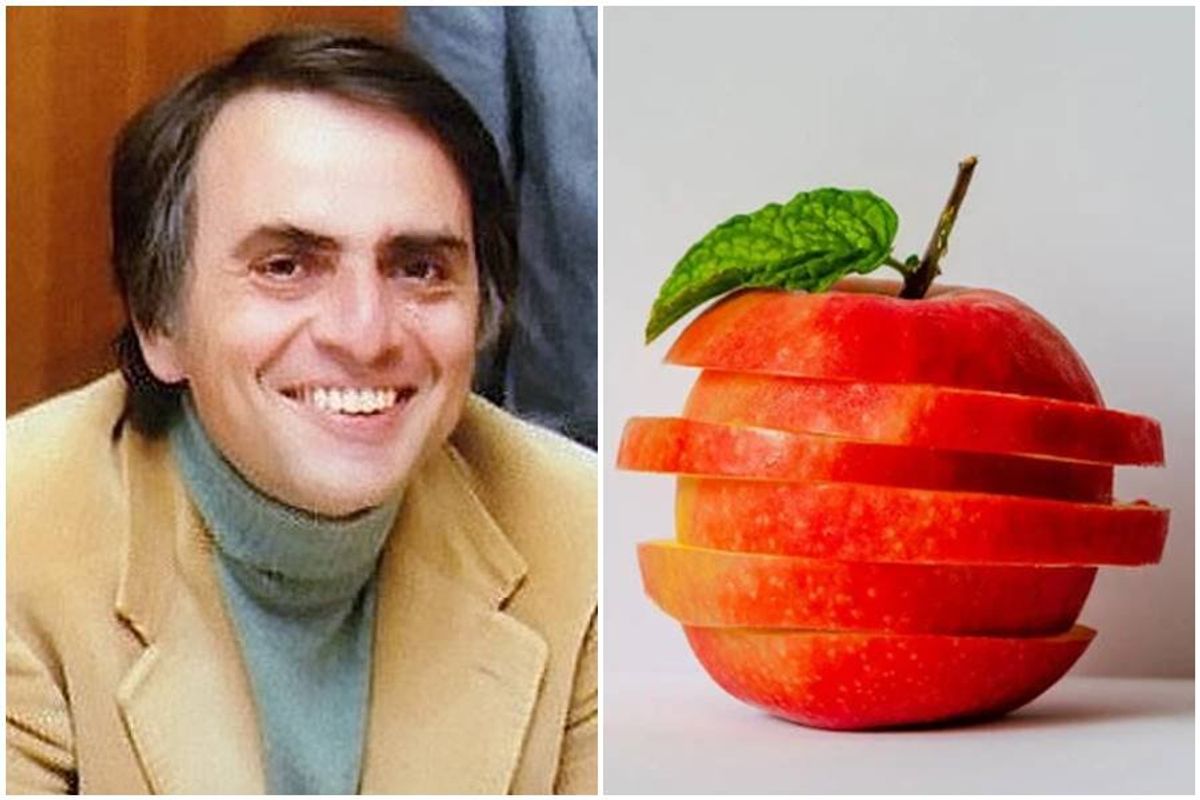

Forty-five years ago, Carl Sagan took a bite out of the universe and handed viewers a slice of the impossible.
In Episode 10 of the legendary 1980 PBS series Cosmos, Sagan set out to explain something few could grasp: the fourth dimension. Not time, as most of us understand it in the context of space-time, but something even more baffling, an extra spatial dimension beyond height, width, and depth. And to bring that abstract idea within human reach, all he needed was an apple and a vivid imagination.
“The universe,” Sagan mused in his gentle, lyrical tone, “might be curved. It might be finite, yet unbounded. But how do we even begin to imagine such things?”
In his trademark style, Sagan asked viewers to imagine a two-dimensional world, where creatures live their entire existence on a flat plane. These beings have no concept of “up” or “down”—only forward, backward, left, and right. Now imagine a three-dimensional apple passing through their world. To them, it doesn’t appear as a whole object.
It reveals itself as a series of bizarre events—dots, lines, widening curves. The full truth of the apple lies beyond their comprehension.
“They don’t see the apple,” Sagan explained. “They only see the slices as it intersects their world.”
To demonstrate, Sagan dipped an apple in ink and stamped it onto a sheet of paper—the universe of Flatland. The result? A trail of changing shapes, each representing the apple’s fleeting contact with the 2D world. For Flatlanders, this would be the only evidence of a mysterious object they could never fully perceive.
Then, Sagan flipped the concept. We are the Flatlanders, he said. Just as a 2D creature cannot grasp 3D space, we three-dimensional beings may be blind to a fourth spatial dimension.
And that’s where the Tesseract or hypercube comes in.
The Tesseract is to a cube what a cube is to a square: a four-dimensional extension that defies human visualization. Sagan used it to illustrate how the fourth dimension might operate—something we can model mathematically, but cannot fully picture. As the apple shifted shape through Flatland, so might a hypercube appear to us, revealing only its “shadows” in our three-dimensional space.
It wasn’t just science, it was storytelling at its finest. Friendly and profound, Sagan was the Mister Rogers of the universe, patiently guiding millions through wormholes of thought that would otherwise remain closed.