
Gold has dazzled investors with a record-breaking rally, but experts caution that the precious metal’s glitter may be masking brewing risks.
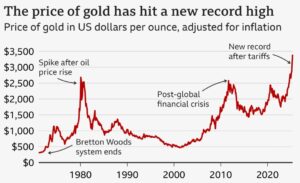
After soaring more than 40% over the past year, gold recently topped $3,500 (£2,630) per troy ounce, its highest value in history, even after adjusting for inflation. The last time gold reached comparable heights was in January 1980, when it briefly touched $850 per ounce, equivalent to $3,493 in today’s money.
The surge has made gold the darling of cautious investors. Behind its meteoric rise lie global uncertainties: unpredictable U.S. trade policy, rising inflation fears, recession risks, and escalating geopolitical tensions. In turbulent times, gold is viewed as a “safe haven”—a stable store of value while stocks and bonds wobble.
“This is the kind of conditions we’d call a perfect storm for gold,” says Louise Street, a senior markets analyst at the World Gold Council. “Inflation concerns, recession fears, and economic downgrades are all fuelling demand.”
Yet seasoned observers are warning: gold may be shining a bit too brightly.
A Double-Edged Investment
Unlike equities, gold pays no dividends. Unlike bonds, it doesn’t offer steady income. And its industrial demand, unlike silver or copper—is relatively small. What gold has in abundance, however, is perception. With only around 216,000 tonnes mined in total, and an annual increase of about 3,500 tonnes, its rarity helps bolster its image as a stable long-term asset.
But history tells a cautionary tale. After dramatic surges, gold has often endured sharp corrections. While it may not crash overnight, it remains a volatile commodity, not the bulletproof hedge some believe it to be.
“People forget that gold is not immune to risk,” says economic strategist Anna Robles. “It may not default like a bond or a stock, but its price can fall dramatically.”
The Role of Central Banks
One major driver of the current rally has been the world’s central banks. Net buyers of gold for over 15 years, their demand has accelerated in recent years. Since 2022, central banks have collectively purchased more than 1,000 tonnes of gold per yeardouble the average from the previous decade.
Countries like Poland, Turkey, India, Azerbaijan and China have led the buying spree, largely as a buffer against global financial instability.
“It’s part of a global diversification play,” says Street. “Gold gives central banks a non-dollar asset to hold, especially in an era of uncertain U.S. monetary policy.”
Forecasts—and Fears
Analysts are split on what lies ahead. Some, like Goldman Sachs, see the rally continuing, projecting $3,700/oz by the end of 2025 and potentially $4,000/oz by mid-2026. In the event of a U.S. recession or intensified trade war, they speculate prices could even reach $4,500 this year.
Economist Daan Struyven adds, “The U.S. stock market is 200 times the size of the gold market. So even a small shift out of stocks or bonds can have a massive impact on gold.”
However, others worry the rapid rise in gold prices is unsustainable. With valuations climbing so steeply, whispers of a bubble are growing louder.
“There’s definitely some froth in the market,” says Robles. “Investors should be careful not to confuse momentum with long-term fundamentals.”