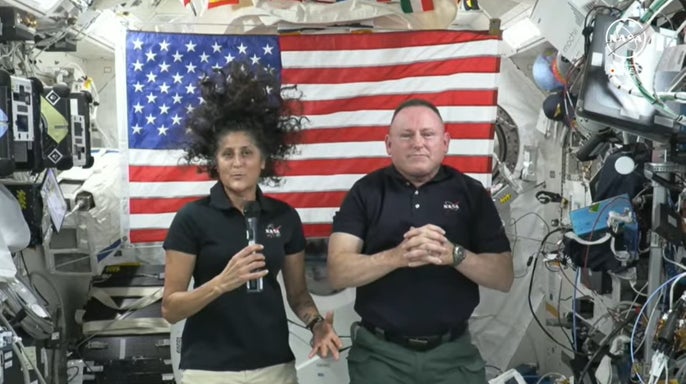

Astronauts stranded aboard the International Space Station (ISS) since June, Suni Williams and Butch Wilmore have experienced an unexpected consequence of their extended stay in space. This has caused temporary changes to their bodies, including increased height and leaner physiques.
A professor at Weill Cornell Medicine and a principal investigator for NASA’s Twins Study, Mason explained that spaceflight induces dynamic shifts in the human body, many of which revert after astronauts return to Earth.
“It’s the first few days that are the most really dynamic when they get back to Earth,” Mason told Fox & Friends.
“The immune system is responding to the stress in spaceflight.”
Mason’s research, which compared astronaut Scott Kelly’s yearlong spaceflight with his identical twin, Sen. Mark Kelly, revealed that microgravity affects gene expression, immune response, and even DNA structures.
One of the most intriguing findings is the lengthening of telomeres; the protective caps on the ends of chromosomes. According to the National Human Genome Research Institute, telomeres typically shorten with age, but in space, they appear to stretch, though they usually return to normal post-mission.
The latest astronauts in orbit, part of Boeing’s first astronaut flight, were only meant to stay for one week; however, technical issues forced NASA to return the Boeing Starliner capsule empty, leaving them aboard the ISS far longer than expected.
While their mission has provided an unexpected scientific opportunity to study long-term exposure to microgravity, the ultimate challenge will be how their bodies readjust when they finally return to Earth.