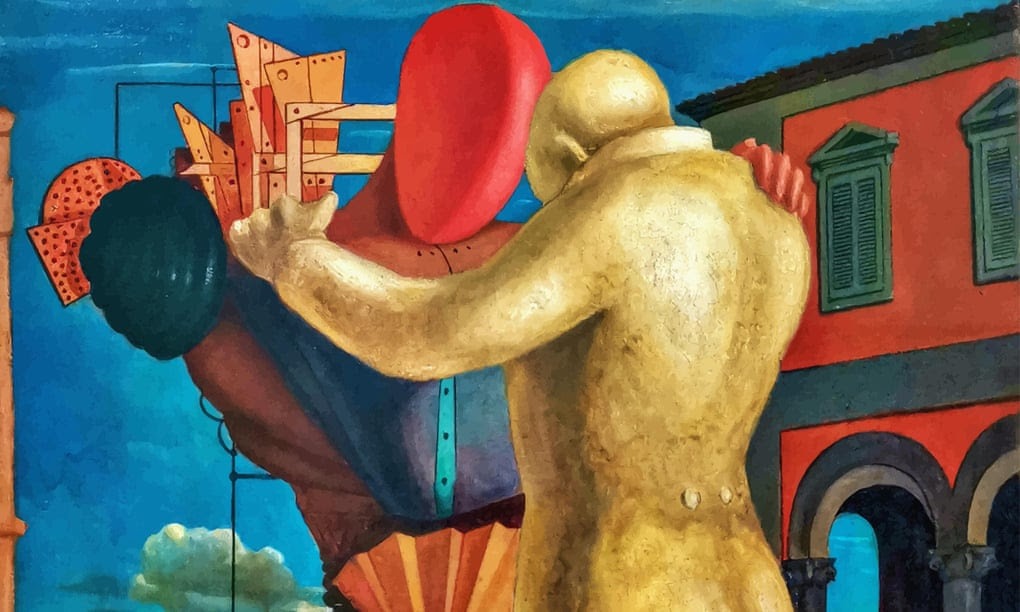

The Prodigal Son
I will meet you in the morning,
in front of the museum, where
you never thought to take me.
I will recognise you in an ancient
stone face, and I will want
to hold you close
in the embrace that you and I,
after all, never had.
And together we will lower our gaze
so as not to see in the eyes the horror
of time passed too quickly,
to finally think of something else.
Translated by David Graham
Analysis
Gabriele Tinti’s poem The Prodigal Son, inspired by Giorgio de Chirico’s 1922 surrealist painting of the same name, offers a profound reinterpretation of the parable we thought we knew.
Taken from Tinti’s recent collection Bleedings: Incipit Tragoedia, the poem not only draws from de Chirico’s enigmatic artwork but also connects it to the poet’s explorations of ancient epigrams and funerary inscriptions. In this dialogue between art forms, Tinti breathes new life into the father-son relationship, reconfiguring the familiar biblical narrative into a deeply contemporary meditation on estrangement, reconciliation, and time.
In de Chirico’s painting, the father—depicted as a cold, grey statue—has stepped down from his pedestal outside what is often identified as the Archaeological Museum of Naples.
The prodigal son, vibrant and constructed from mismatched materials, confronts him with an energy and flamboyance that sharply contrasts the father’s rigid, shrunken form. Neither figure’s face is visible, a detail that invites interpretations of ambiguity in their embrace. Some critics have read this gesture as a refusal of connection, but Tinti’s poem gently challenges this reading, offering a more nuanced take on their relationship.
Tinti approaches his ekphrastic task with remarkable subtlety. His poem doesn’t merely reflect de Chirico’s vision but instead builds on it, creating a narrative that humanizes the surreal figures. The son becomes the sole voice in the poem, speaking in measured tercets that transform him into a modern, introspective character. In this reimagining, the son is not merely a rebellious figure returning to seek forgiveness; he is a person burdened by pain, longing, and the complexity of familial bonds.
The poem begins with the son’s promise: “I will meet you in the morning.” This statement, addressed to the father the night before the encounter in de Chirico’s painting, establishes a timeline that the artwork doesn’t capture. The poem’s chronology creates a sense of anticipation and intimacy, providing context that the painting’s frozen moment lacks. By framing the embrace as a deliberate act, Tinti makes it less about spectacle and more about the private, unseen struggles of a father and son reconnecting.
The son’s reflection on his father is laced with sorrow and resilience. “I will recognise you in an ancient / stone face,” he says, the line break creating a poignant pause, as though grappling with disbelief or grief. The father’s stoniness is literal and metaphorical—his coldness and rigidity shaped by age, time, and perhaps emotional distance. Yet, the son’s recognition persists, suggesting that intimacy can transcend even the hardest of barriers.
Tinti acknowledges the father’s failings, with the son remarking on their chosen meeting place: “the museum, where / you never thought to take me.” This quiet statement, spoken without overt rancor, carries the weight of years of neglect. The embrace they share will be “one that you and I, / after all, never had.” These lines subtly hold both accusation and acceptance, their understated tone revealing the son’s measured effort to forgive.
The poem transforms the parable’s moral dynamics. Here, it is the son who reaches across time and space to bridge the gap between them. The biblical father, steadfast and waiting, is replaced by a faltering figure whose uncertain embrace speaks of missed opportunities and unspoken regrets. The son’s voice, steady and determined, suggests a reversal of roles—a parent in need of salvation and a child willing to grant it.
Ultimately, Tinti’s The Prodigal Son offers not just a reinterpretation of de Chirico’s painting but an entirely new dimension of meaning. The poem navigates the tension between estrangement and reconciliation, highlighting the complexities of familial relationships. Through its restrained yet evocative language, it opens a space where readers can confront their own experiences of distance, forgiveness, and the passage of time.
Tinti’s work reminds us that even in the coldest, hardest places, there remains the possibility of recognition, connection, and healing.