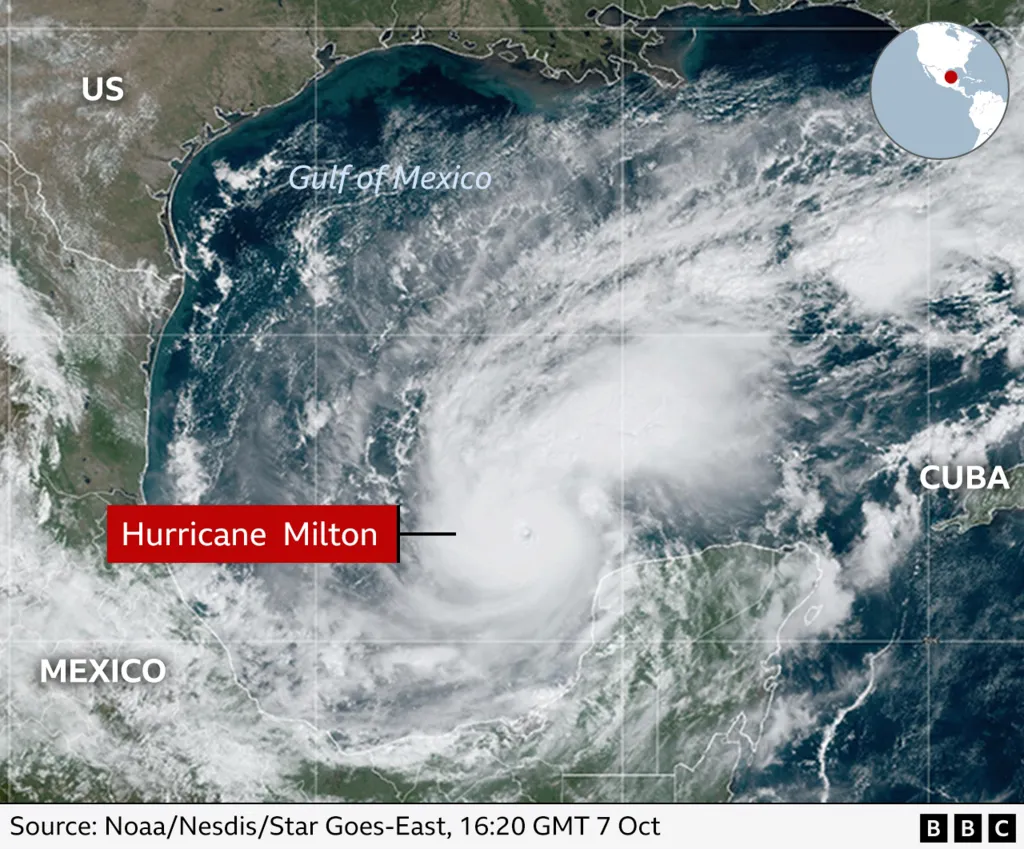

Hurricanes are often given names that sound benign, even beautiful. However, their impacts are anything but easy. This year’s hurricane season has been no exception, with Hurricane Milton now posing a severe threat to Florida. After briefly escalating to a category five storm, Milton has downgraded to category four but remains highly dangerous, packing winds of up to 155mph (250km/h). As it barrels toward the highly populated Tampa Bay area, Floridians are bracing for the worst.
Milton is About to Strike
Hurricane Milton’s trajectory and power make it a grave concern, especially in the wake of Hurricane Helene, which struck less than two weeks ago, leaving over 200 dead and hundreds more missing. Governor Ron DeSantis has urged residents to heed evacuation orders as the storm inches closer. Florida is now facing one of its most significant evacuation efforts in years, as authorities try to avoid further loss of life.
As Milton approaches, forecasters from the National Hurricane Center (NHC) have warned of “potentially catastrophic” storm surges, especially along Florida’s west coast. These surges could reach heights of 10-15 feet, potentially inundating coastal areas. In addition to the surge, the storm is expected to unleash torrential rain and flash floods, adding to the already high risk of destruction.
Looking at recent trends in hurricane behavior, there has been a concerning pattern of storms rapidly intensifying before making landfall. Hurricane Milton is a prime example, with its wind speeds increasing by 80 knots in just 24 hours, making it one of the fastest-intensifying hurricanes on record.
As climate change continues to warm ocean waters, experts warn that such rapid intensification could become more common, leading to stronger, more destructive storms in the future.
With Milton likely to cause significant damage, recovery efforts will likely mirror the prolonged clean-up still underway after Hurricane Helene. Over 12,000 cubic yards of debris have already been removed from Helene-affected areas, but much more remains to be done. Roads remain closed, hampering relief efforts, and thousands are still without power. For Floridians, Milton is yet another blow in a devastating hurricane season that could take years to recover from.
While immediate focus is on protecting lives and property, the frequency and intensity of these storms raise questions about long-term resilience. Florida, like much of the US Gulf Coast, remains highly vulnerable to hurricanes. As federal assistance pours in, including the deployment of additional troops and relief workers, the importance of disaster preparedness and infrastructure resilience is becoming increasingly apparent.
Forecasts suggest that Hurricane Milton could weaken slightly before making landfall, possibly as a category three storm. However, even at this level, it poses a significant threat to life and property. Emergency services are on high alert, and evacuation centers, like the one set up at Tropicana Field, are filling up as residents seek shelter from the impending storm.
In the long term, more comprehensive solutions are needed to combat the increasing ferocity of hurricanes. As storms become more powerful, government policies must evolve to focus not just on immediate disaster response but also on sustainable infrastructure development, climate mitigation, and community resilience efforts. The current hurricane season serves as a stark reminder that these storms, while natural, are growing more dangerous with each passing year.