Cycling: India’s Silent Revolution in Female Mobility

Cycling out of the rhetorics.
Cycling is becoming a key focus in global policy discussions, recognized for its environmental benefits, health advantages, and potential to revolutionize urban mobility. In 2024, the European Commission took a significant step by adopting the European Declaration on Cycling, formally acknowledging cycling as a standalone mode of transport across the European Union.
The Intergovernmental Panel on Climate Change (IPCC) also saw cycling as a critical measure for reducing carbon emissions, an essential component of ensuring our planet’s future sustainability. Beyond environmental impact, cycling is increasingly seen as a tool for improving public health, offering substantial reductions in mortality risks.
In India, the spotlight on cycling has taken on a unique and transformative role, particularly for schoolchildren. Cycling to school has not only improved access to education but also offers vital physical activity and fosters independence among young students. Yet, there is a notable gap in understanding the prevalence and patterns of cycling to school across India. Over the past decade, national data reveals a promising trend: the percentage of students cycling to school has increased from 6.6% in 2007 to 11.2% in 2017.
Interestingly, the rise in cycling is more pronounced in rural areas, where the rate of students cycling to school has doubled. In urban regions, however, this rate has remained stagnant, a likely consequence of poor traffic safety and the proliferation of motor vehicles on city roads. Indian cities are notorious for their chaotic traffic, which poses significant risks to cyclists, particularly children.
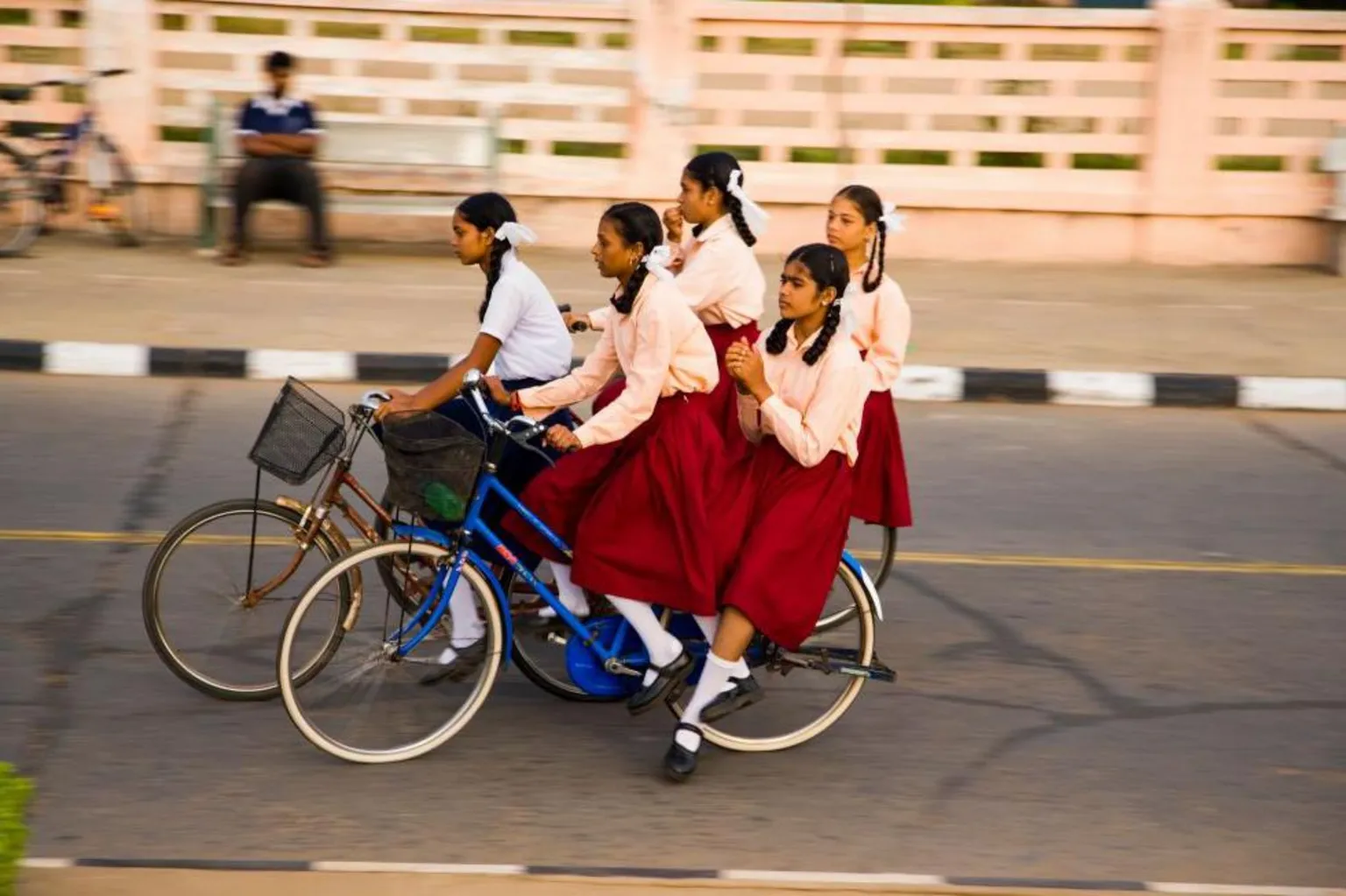
One of the most remarkable findings comes from the work of researcher Srishti Agrawal, who observed that the most significant increase in cycling in India has been among rural girls. Their participation in cycling more than doubled, from 4.5% in 2007 to 11% in 2017, a change that Agrawal describes as a “silent revolution.” This growth is particularly striking in a country where gender inequality is prevalent, especially regarding female mobility outside the home.
Agrawal reflects on this transformation.
“We call it a revolution because cycling levels increased among girls in a country which has high levels of gender inequality in terms of female mobility outside the home, in general, and for cycling, in particular.”
Her observations echo the sentiments of American suffragist Susan B. Anthony, who famously declared that the bicycle “has done more to emancipate women than anything else in the world. It gives women a feeling of freedom and self-reliance.”
Despite this progress, there are concerns about whether women continue cycling as they age, particularly as they face shrinking job opportunities and societal expectations. For instance, Nibha, who once cycled freely, stopped after getting married and moving in with her in-laws. While she still commutes outside the home to train as a teacher, she dismisses the need for a bicycle, stating simply, “I don’t need the cycle anymore.”
The shift in cycling habits among girls in India can be attributed, in part, to state-run bicycle distribution schemes that have been in place since 2004. These programs specifically target girls, who traditionally had higher dropout rates from school due to household responsibilities and the physical exhaustion of long walks to school.
While similar initiatives exist in countries like Colombia, Kenya, Malawi, and Zimbabwe, where bicycles have proven effective in boosting girls’ school enrollment and retention, the scale of India’s efforts is unparalleled.
India’s experience with cycling, particularly among young girls in rural areas, offers a powerful example of how targeted interventions can create significant social change.
The increase in cycling not only challenges traditional gender norms but also opens up new possibilities for educational access and empowerment.