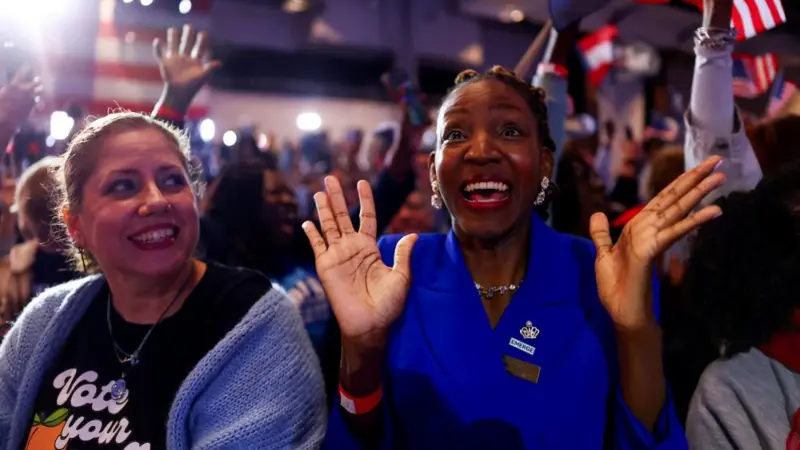

For months, Democrats had been searching for a way back into power in Washington. On election night, American voters handed them more than they had dared to expect: control of both chambers of Congress and a fresh opportunity to challenge President Donald Trump during the final two years of his presidency.
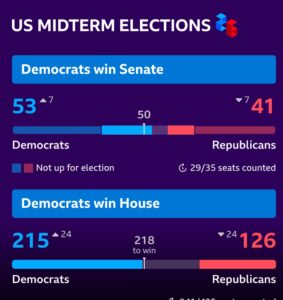
The results of Tuesday’s midterm elections have reshaped the political landscape, with Democrats recording victories in states that had long been regarded as Republican strongholds. From Texas and Ohio to Kansas, Iowa and the Carolinas, the party made gains that have altered the balance of power in Washington.
At the centre of the political upheaval is a familiar concern among American voters: the cost of living.
Rising household expenses, higher fuel prices and public dissatisfaction with the administration’s handling of the war with Iran featured prominently in the election debate. For many voters, the midterms became an opportunity to express their frustration with the direction of the country and the policies of the president.
The outcome is a significant setback for Trump, who returned to the White House in January 2025 with Republicans controlling both chambers of Congress. That political advantage had allowed his administration considerable room to advance its legislative priorities.
The new Democratic majority changes that equation.
With control of the House of Representatives and the Senate, Democrats will have greater power to scrutinise the administration, investigate its activities, challenge nominations and block legislation they oppose. The prospect of renewed impeachment proceedings could also enter the political conversation, although any such move would face its own political and constitutional hurdles.
Texas delivers a defining upset
Perhaps the most consequential individual contest of the night came from Texas, where Democrat James Talarico defeated Republican Ken Paxton in a Senate race that attracted national attention.
Talarico’s victory marks the first time since 1988 that a Democrat has won a US Senate seat in Texas, a state that has remained firmly in Republican hands in recent decades.
A former public school teacher and state legislator, Talarico built his campaign around the rising cost of living, public education and allegations of political corruption. His message found support among voters who had become increasingly concerned about household expenses and the direction of the economy.
Paxton, Texas’ attorney general and a close Trump ally, sought to portray Talarico as too progressive for the state. He received the president’s backing and campaigned with him on several occasions, making the contest an important test of Trump’s influence in a state he had carried comfortably in the 2024 presidential election.
But the Republican campaign could not prevent Talarico from securing a historic victory.
The result also exposes the changing electoral calculations facing Republicans in Texas, where Democrats have repeatedly struggled to convert growing support in urban centres and suburban communities into statewide victories.
Talarico’s win is particularly significant because it comes after years of Republican dominance and gives Democrats a Senate seat in a state that had been central to the party’s electoral map.
A wider rejection of Republican strongholds
Texas was not the only state where Democrats made significant gains.
The party also secured victories in Ohio, Kansas, Iowa, Maine, North Carolina and South Carolina, among other contests. The results challenged assumptions about the strength of Republican support in states that had backed Trump and his party in previous elections.
Kansas attracted particular attention because of the rarity of Democratic success in its Senate contests over several generations. Ohio and Iowa also featured prominently in the wider shift in voting patterns.
The scale of the gains suggests that the election was not simply a collection of isolated victories. It reflected a broader change in the political mood, with Democrats making advances across different regions and voter groups.
For Republicans, the losses are especially significant because Trump had personally invested in the campaigns of several candidates, urging supporters to treat the midterms as a referendum on his presidency.
Although his name did not appear on the ballot, the president remained central to the campaign. His endorsements, rallies and public interventions made the election closely tied to his leadership.
Trump later acknowledged the Democrats’ performance, telling CBS that they had “done a good job”. He also recognised that the war with Iran and higher fuel prices had contributed to the Republican losses.
He nevertheless argued that Republicans would have won decisively if he had been on the ballot, insisting that his absence from the contest was an important distinction.
In another response, Trump signalled a willingness to negotiate with congressional Democrats, saying he did not want to spend the remaining two years of his presidency simply rejecting their proposals.
That conciliatory tone, however, was accompanied by a reminder of the partisan divisions ahead. The president subsequently posted an image of his familiar red baseball cap bearing the word “veto” on his Truth Social platform.
What happens next in Washington?
The change in congressional control is likely to introduce a new phase of political confrontation in the United States.
A Democratic-controlled House can initiate investigations into the administration, summon officials to testify and exercise oversight over federal agencies. Control of the Senate will also give the party greater influence over legislation and presidential nominations.
For Trump, whose second term began with Republican control of Congress, the new political reality means that advancing his legislative agenda will require negotiations with an opposition party that now has considerable institutional power.
The possibility of impeachment could also return to the agenda. Democrats would have the ability to initiate proceedings in the House, but removing a president requires a two-thirds majority in the Senate, a threshold that remains difficult to achieve.
Beyond Washington, the election has raised questions about the future direction of both parties as they begin preparing for the next presidential contest in 2028.
For Democrats, the victories provide an opportunity to rebuild political momentum and demonstrate that their message can attract voters beyond traditional strongholds. For Republicans, the results present a challenge to a party whose fortunes have become closely associated with Trump’s political leadership.
The most immediate message from the ballot box, however, concerns the concerns that shaped voters’ decisions: the cost of everyday life, the price of fuel and the consequences of the administration’s policies at home and abroad.
The midterms have not ended Trump’s presidency, but they have changed the political environment in which he must govern. For the remainder of his term, the White House will face a Congress controlled by Democrats, turning what began as a Republican-controlled second presidency into a period of divided government.