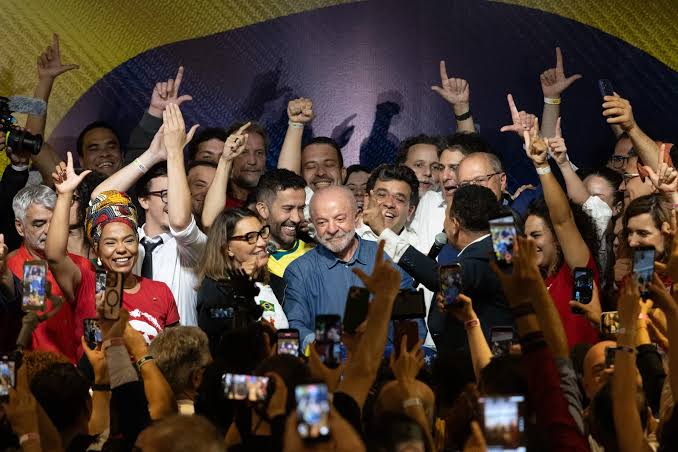

Brazil’s President Luiz Inácio Lula da Silva has won a fourth non-consecutive term in office, defeating right-wing challenger Flávio Bolsonaro in a tightly watched run-off and declaring that Brazilian democracy had been defended at the ballot box.
The 80-year-old left-wing leader secured just under 52% of the vote, a margin of roughly 4.4 million ballots, and thanked jubilant supporters in São Paulo in a victory speech that cast the result as a vindication of the country’s democratic institutions.
The result capped a remarkable political career for Lula, a former metalworker and founding figure of the left-wing Workers’ Party. He previously served two terms from January 2003 to December 2010 and returned to the presidency in January 2023.
His latest win makes him the only Brazilian president to have won four non-consecutive elections, cementing a comeback that his allies describe as one of the most extraordinary in modern Latin American politics.
Flávio Bolsonaro, who had finished ahead in the first round, refused to accept the outcome, calling the result “inexplicable” and demanding that it be annulled.
His father, former President Jair Bolsonaro, is currently serving a jail sentence under house arrest for plotting a coup after losing the last election, a backdrop that has made the younger Bolsonaro’s challenge especially charged.
The defeat extends a difficult period for the Bolsonaro family and for the Brazilian right, which had hoped to reclaim the presidency after Lula’s return.
Legal experts, however, poured cold water on any prospect of annulment. Fernando Neisser, an electoral law specialist at the Institute of Lawyers of São Paulo, said overturning the result would be “difficult from a legal standpoint” and would depend heavily on the narrative Bolsonaro’s lawyers could construct. He pointed to the size of Lula’s victory, noting that a gap of 4.4 million votes made annulment seem unlikely. Alberto Rollo, another electoral law expert, added a constitutional obstacle: Brazil’s presidential election dates are fixed by the constitution, meaning the result cannot simply be discarded and rerun on a later date. “We can’t change the constitution,” he said. “We can’t say ‘it didn’t count, we’ll do it next week, or on 15 November, or 30 November.’”
The run-off followed a first round in which Bolsonaro finished ahead, raising expectations on the right that the presidency might change hands. Lula’s campaign instead consolidated support in the second round, drawing on his longstanding appeal among working-class voters and his record of social programmes from his earlier terms. In his victory address, he singled out younger voters who, he said, had taken to the streets to “defend democracy,” framing the result as a collective stand against attempts to undermine the electoral process.
Lula’s environmental record also loomed over the campaign. During the 2022 election, supporters hailed him as the “saviour of the Amazon,” praising his commitment to protecting the rainforest after years of rising deforestation under Jair Bolsonaro. More recently, however, some environmentalists have criticised his stance on exploratory oil drilling near the mouth of the Amazon, a sensitive issue that has tested his green credentials and exposed tensions within his coalition.
With the result now certified and the legal path to annulment widely seen as remote, attention turns to how Lula will govern in his fourth term. He inherits a polarised country, a hostile opposition still questioning the legitimacy of the vote, and the challenge of delivering on promises of economic stability and environmental protection. For now, his supporters are celebrating a victory they see as a defence of democracy itself, while his opponents are left to reckon with another defeat at the hands of the man they have repeatedly tried to keep from power.