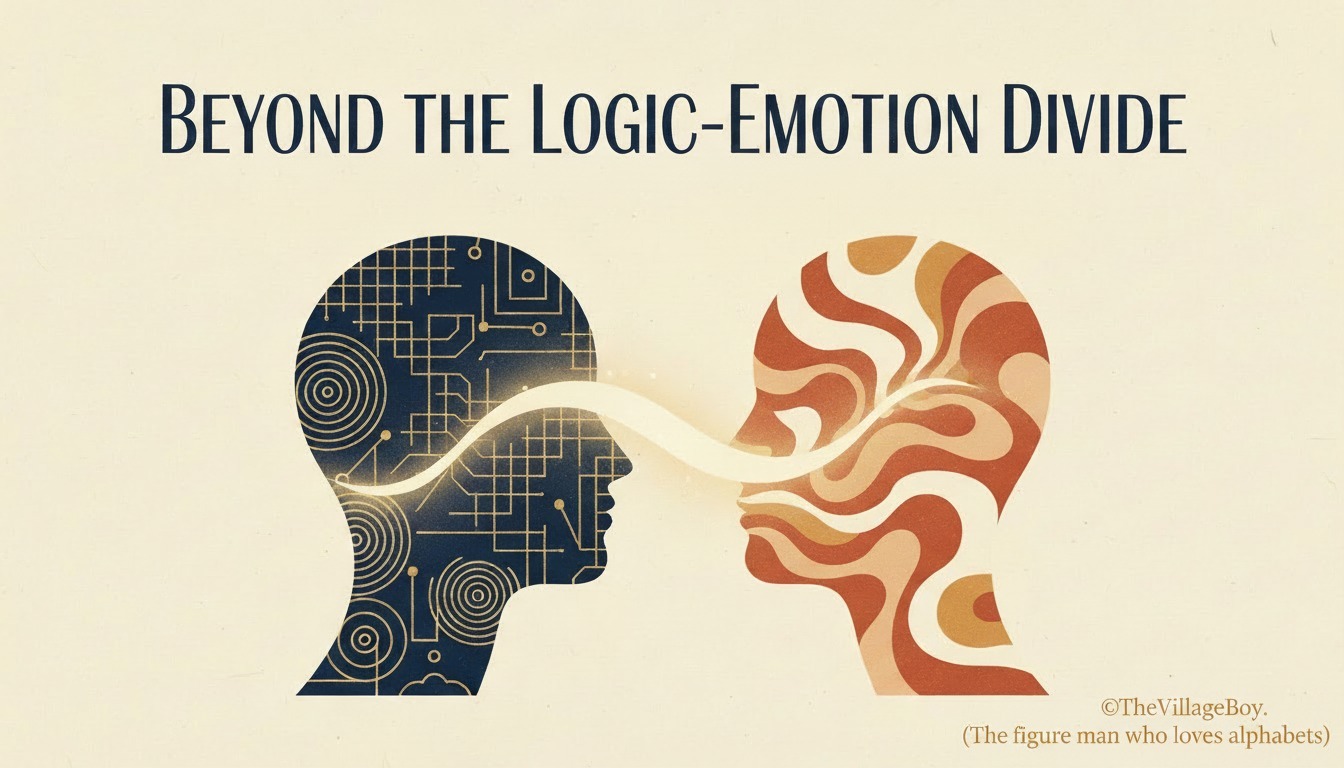

Beyond the Logic-Emotion Divide
In recent times, I have become more deliberate about avoiding extremes and resisting the seductive pull of absolutism. I have come to see how easily we can become trapped by rigid categories, especially when they claim to explain human beings too neatly.
Years ago, my manager gave me Men Are from Mars, Women Are from Venus by John Gray, PhD, as a birthday gift. Looking back, I still cannot tell whether it was given mischievously or simply in response to my curious appetite for learning. What I do remember is that books were her usual gift to me, year after year.
The book seeks to explain differences in how men and women see the world.
I do not have a problem with attempts to understand human differences.
What troubles me is the tendency to turn broad observations into impenetrable silos, then insist that everyone must live within them.
For far too long, we have accepted the idea that men are naturally logical and women are naturally emotional. This is not only simplistic; it is damaging. It can make it seem strange for a woman to be analytical, decisive, or intellectually rigorous. It can also make it seem weak for a man to be vulnerable, expressive, or deeply moved.
Many men have paid a heavy price for being taught that emotional expression is incompatible with masculinity. Some have lived with silent pain. Some have struggled alone. Some may even have lost years of their lives because they were conditioned to suppress what they felt rather than seek help, speak openly, or lean on others.
The narrative is changing, thankfully, but perhaps not quickly enough.
Take Samson, for example. If logic alone governed his choices, repeated attempts to discover the source of his strength should have made him more cautious about Delilah’s intentions. Yet he continued until he fell into a trap that clearer judgment might have helped him avoid.
That does not mean emotion is stronger than logic in every situation. It means that human beings are more complicated than the false contest between logic and emotion suggests.
Emotion can influence our decisions powerfully. Love, fear, pride, grief, desire, loyalty, anger, and hope can all shape the choices we make. But emotion is not automatically a weakness, just as logic is not automatically wisdom. A person can be highly rational and still make poor choices. Another person can be emotionally expressive and still possess excellent judgment.
The better question is not whether logic is stronger than emotion. The better question is whether we are learning to use both well.
Logic helps us examine evidence, challenge assumptions, anticipate consequences, and make careful decisions. Emotion helps us recognize what matters, connect with others, notice injustice, respond to loss, and understand ourselves. Neither should be treated as the enemy of the other.
This is why the old gender divide is so unhelpful.
When we assume men should be logical, stoic, and emotionally restrained, we pressure them to hide vulnerability. When we assume women should be emotional, intuitive, and less rational, we deny their intellectual agency and unfairly reduce their contributions. Both assumptions place people in narrow boxes that do not reflect the full range of human experience.
We have all encountered men who are openly emotional and highly analytical women. Yet we often judge them through the lens of stereotypes. An emotional man may be seen as less masculine. A logical woman may be treated as unusual, difficult, or somehow less feminine. These judgments reveal more about our social conditioning than about the people being judged.
In recent years, there has been increasing attention to emotional intelligence. This is a welcome development, provided we understand it properly. Emotional intelligence is not the replacement of logic with feelings. It is the ability to recognize, understand, express, and regulate emotions in ourselves and in others.
Used well, emotional intelligence strengthens rather than weakens sound judgment. It can make us better leaders, partners, parents, colleagues, and friends. It can help us listen before reacting, communicate more honestly, and make decisions that account for both facts and human consequences.
There is nothing wrong with anyone, regardless of gender, developing a healthy balance of logic and emotion. If I need to cry, I should be able to cry without being judged as weak. If a woman wants to reason carefully, speak directly, or make a difficult decision, she should not be treated as though she has crossed into someone else’s territory.
Logic and emotion are not separate domains assigned to different genders. They are shared human capacities.
Perhaps we need to stop asking whether emotion is weak or whether logic is supreme. Emotion can overwhelm us when it is unmanaged, but logic can also fail us when it becomes cold, proud, detached, or blind to human realities. Wisdom lies not in choosing one over the other, but in allowing each to inform the other.
Creating an unnecessary divide between logic and emotion is a disservice to everyone. It limits men by making vulnerability appear shameful. It limits women by making reason appear unnatural or unexpected. It prevents all of us from becoming more complete human beings.
Let us break the false dichotomy.
Let us make room for reason and feeling, analysis and empathy, thoughtfulness and vulnerability. Let us stop treating logic as masculine and emotion as feminine. A reasonable and fulfilled life requires both.
Come out of the box we have been constrained in for too long.
What are your thoughts?
©TheVillageBoy.
(The figure man who loves alphabets)