

The Premier League’s latest transfer window has delivered another reminder that elite midfielders have become football’s most valuable assets.
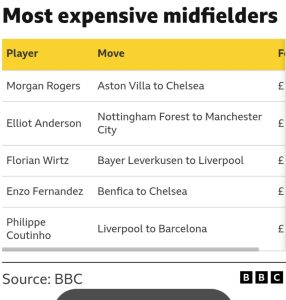
Within days, England internationals Elliot Anderson and Morgan Rogers shattered the British transfer record. Anderson completed a reported £116 million move from Nottingham Forest to Manchester City before Chelsea eclipsed that fee by signing Rogers from Aston Villa for £117 million.
The eye-watering deals raise an obvious question: Why are Premier League midfielders, particularly young English talents, commanding such extraordinary prices?
The answer lies in a combination of quality, versatility, scarcity and economics.
The Complete Modern Footballer
Football has evolved dramatically over the past decade. The days when midfielders specialised solely in defending or creating chances are disappearing. Today’s elite midfielder is expected to defend aggressively, dictate possession, create scoring opportunities and contribute goals.
Anderson and Rogers perfectly embody that evolution.
At just 23, both players combine Premier League experience with years of development still ahead of them. Clubs are not only paying for what they already produce but also investing in what they could become over the next decade.
Elliot Anderson: The Complete Engine
Manchester City were convinced Anderson possesses every attribute required of a modern central midfielder.
Last season, despite Nottingham Forest battling relegation, Anderson dominated the Premier League’s statistical rankings.
He registered 3,300 touches, the most by any player in the division. He also led the league in duels won (297), possessions regained (306), fouls won (80) and completed 2,038 passes as a central midfielder.
Perhaps most impressively, he produced 376 line-breaking passes, demonstrating his ability to progress attacks through intelligent distribution.
Those defensive numbers were complemented by attacking contributions of four goals, four assists and 54 chances created, proving he influences every phase of the game.
His performances continued on the international stage, where he started seven of England’s eight World Cup matches as the Three Lions finished third.
Morgan Rogers: A Creative Match-Winner
Chelsea’s investment in Morgan Rogers reflects a different but equally valuable profile.
Unlike Anderson, Rogers thrives in advanced positions. Comfortable as a No.10 or operating from the left, he offers tactical flexibility that elite clubs increasingly demand.
Last season, he produced 14 goals and 12 assists in 55 appearances for Aston Villa, establishing himself as one of Europe’s most productive attacking midfielders.
Across Europe’s top five leagues, Rogers ranked second among midfielders for touches inside the opposition penalty area (181), while his 16 Premier League goal involvements placed him among the continent’s elite players in his position.
His ability to score, create and operate across multiple attacking roles makes him an ideal fit for modern possession-based football.
Why English Midfielders Command Premium Fees
Their nationality also plays a significant role.
Premier League clubs must satisfy homegrown player regulations, making elite English talent especially scarce. When world-class English players become available, competition naturally inflates transfer fees.
Unlike importing foreign stars who require adaptation, Anderson and Rogers have already proven themselves in the Premier League’s demanding environment.
For clubs chasing immediate success, that certainty carries enormous value.
Youth Equals Investment
At 23, neither player has reached his peak.
Most midfielders mature between the ages of 26 and 29, meaning both Anderson and Rogers could deliver eight to ten years of elite performances.
That longevity allows clubs to justify spending over £100 million, knowing they are acquiring cornerstone players rather than short-term solutions.
The Next Generation Is Already Waiting
The remarkable fees paid for Anderson and Rogers may not stand for long.
England’s production line continues to deliver technically gifted midfielders, with Adam Wharton and Alex Scott already attracting interest from Europe’s biggest clubs.
The country’s coaching system has increasingly prioritised technically intelligent midfielders capable of dominating possession while contributing defensively and offensively.
As tactical demands continue to evolve, complete midfielders have become football’s rarest commodity.