

We are living in an age of excess; excess information, excess speed, excess convenience. Tools like ChatGPT, Google Gemini,Meta AI and Claude are gradually and infinitely reshaping how we think, write, learn and even decide. Aww shocks!
Yes, they are efficient, responsive, and on the surface remarkably helpful. But beneath that convenience lies a more uncomfortable question: what happens to the human mind when it stops doing the heavy lifting?
The idea that AI could make us “stupider” isn’t as far-fetched as it sounds. At Massachusetts Institute of Technology, researcher Nataliya Kosmyna has been exploring exactly this concern. Observing her students over time, she noticed something subtle but worrying: they were forgetting things more easily. That observation led to an experiment that now feeds into a growing global debate about “cognitive offloading”, the habit of outsourcing thinking to machines.
Does AI infringe on our residual thinking?
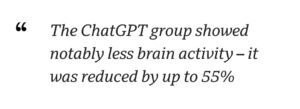
In her study, students were divided into three groups: one used AI tools like ChatGPT, another relied on traditional search engines, and a third worked without any digital assistance. The difference was striking. Those who worked unaided showed intense, widespread brain activity, what Kosmyna described as a brain “on fire.” The AI-assisted group, however, showed significantly reduced engagement, with brain activity dropping by as much as 55%.
The implication isn’t that AI is inherently harmful, it’s that overreliance might be. When we consistently let machines generate ideas, structure arguments, or even complete simple tasks, we risk dulling the very cognitive muscles that define human intelligence: critical thinking, memory, creativity, and judgment.
This concern is rehashed in other research. A study from the University of Pennsylvania describes a phenomenon called “cognitive surrender,” where users accept AI-generated answers with little scrutiny. It’s not just convenience, it’s quiet compliance. Over time, this can erode our instinct to question, analyse, or even disagree.
More alarmingly, the effect isn’t limited to casual users. In high-stakes environments, the pattern repeats. Medical professionals who relied on AI tools to detect colon cancer reportedly became less accurate when the tools were removed. The brain, it seems, adapts quickly, not always in ways that serve us.
So, does AI make us less intelligent? Not necessarily. But it can make us less engaged, less curious, and less independent if used passively. The real danger is not the tool itself, but the way we use it.
There’s a more balanced path forward, what some experts call “hybrid intelligence.” The idea is simple but powerful: think first, then use AI to challenge or refine your thinking, not replace it. Build your mental framework before leaning on digital assistance. Learn deeply before you automate.
Because intelligence isn’t just about having answers, it’s about the process of getting there. Struggle, doubt, iteration, these are not inefficiencies; they are the essence of human cognition.
AI can amplify us, but it can also diminish us if we surrender too much. The responsibility, ultimately, is not on the machine, but on us to decide whether we remain thinkers or become merely operators of intelligence we no longer fully understand.