
A lot of lawyers are already reacting to thia development. Some describes it as the most significant climate deregulation in American history.
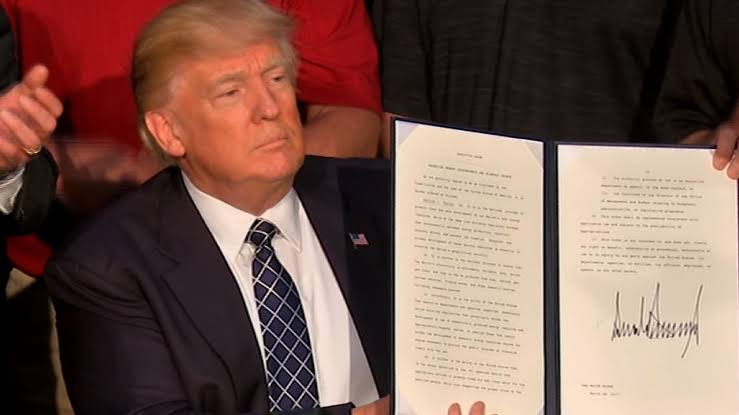
President Donald Trump has formally reversed the 2009 “endangerment finding”, the scientific and legal cornerstone of federal efforts to regulate planet-warming pollution for the past sixteen years.
Signed recently behind the Resolute Desk in the Oval Office on Thursday, the reversal dismantles the Obama-era determination that six greenhouse gases, including carbon dioxide and methane, pose a direct threat to public health and welfare. That single conclusion has underpinned virtually every major climate regulation enacted since, from vehicle emissions standards to power plant rules and methane controls on oil and gas operations.
“This radical rule became the legal foundation for the Green New Scam, one of the greatest scams in history,” Trump told reporters, framing the rollback as both economic relief and ideological warfare against what his administration terms the climate agenda of the Democratic left.
The White House press secretary, Karoline Leavitt, described the action as the “largest deregulation in American history” and estimated it would reduce costs for automakers by approximately $2,400 per vehicle, savings she said would be passed directly to consumers through lower car prices.
But even as the administration celebrated what it calls liberation from overreach, former President Barack Obama broke his characteristic silence on successor policies to issue a stark warning. Writing on X, Obama said the repeal would leave Americans “less safe, less healthy and less able to fight climate change, all so the fossil fuel industry can make even more money.”
The stage is now set for a legal confrontation that could reach the Supreme Court and determine, once and for all, whether the United States retains any federal authority to address the accelerating realities of a warming planet.
Contingent on the dispute is a document few Americans have ever read but whose consequences touch nearly every facet of modern life. The 2009 endangerment finding, issued by the Environmental Protection Agency in the first year of Obama’s first term, was itself the product of a Supreme Court battle. In Massachusetts v. EPA, the high court ruled that greenhouse gases fell within the Clean Air Act’s definition of air pollutants and directed the agency to determine whether they endangered public health.
The agency’s answer was unequivocal: yes.
What followed was not merely regulation but an entire architecture of climate governance. Because Congress remained divided on comprehensive climate legislation, cap-and-trade died in the Senate, the Green New Deal never advanced, the endangerment finding became the indispensable legal foundation upon which everything else was constructed.
“The endangerment finding has really served as the lynchpin of US regulation of greenhouse gases,” said Meghan Greenfield, a former EPA and Department of Justice attorney now practising environmental law in Washington. “So that includes motor vehicles, but it also includes power plants, the oil and gas sector, methane from landfills, even aircraft. It really runs the gamut. All of the standards for each of these sectors is premised on this one thing.”
Remove the lynchpin, Greenfield and her colleagues warn, and the entire structure becomes unstable.
The Trump administration’s justification is unapologetically economic. Officials project that overturning the finding will save Americans more than one trillion dollars in cumulative regulatory compliance costs and accelerate the administration’s broader project of energy dominance. Lower vehicle prices, cheaper electricity, reduced burdens on domestic manufacturing, these are the promised fruits of what the White House frames as liberation from green orthodoxy.
Environmental groups, however, have produced counter-calculations that paint a dramatically different picture of the costs of deregulation.
“It’s going to force Americans to spend more money, around $1.4tn in additional fuel costs to power these less efficient and higher polluting vehicles,” said Peter Zalzal of the Environmental Defense Fund, whose organisation has spent decades litigating and defending federal climate protections. “We’ve also analysed the health impacts and found that the action would result in up to 58,000 additional premature deaths, 37 million more asthma attacks.”
The numbers are divergent because they count different things. The administration counts compliance costs avoided. Environmentalists count fuel expenditures incurred and lives shortened by polluted air. Neither side acknowledges the other’s accounting as legitimate, and the chasm between them is now the terrain upon which the coming legal war will be fought.