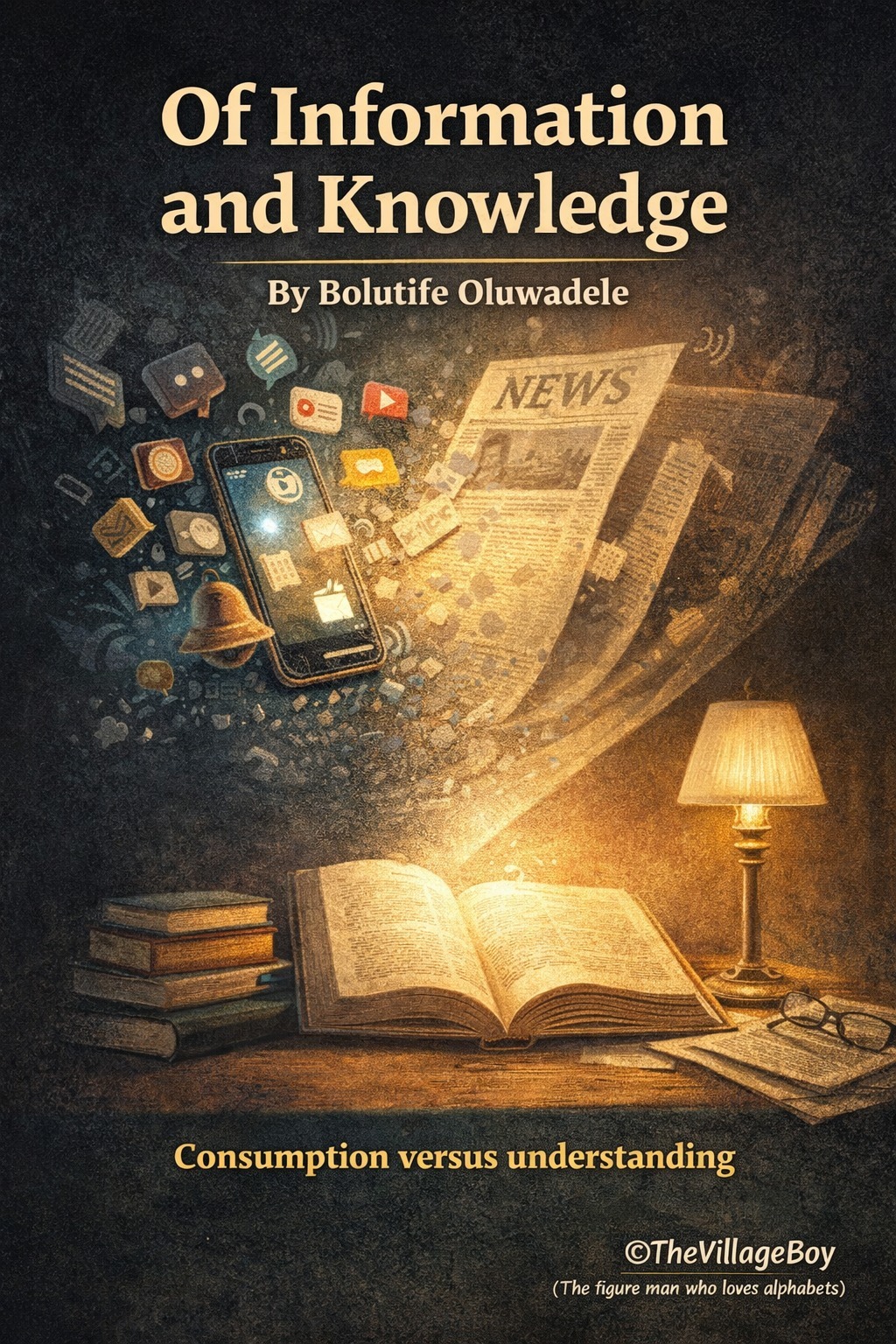

Of Information and Knowledge Reflections by Bolutife Oluwadele
“Please, I need to watch the news.”
“D wan you watch yesterday, wetin you take am do?”
This may sound funny, right?
Yes, it should!
Right from way back in Nigeria, there was an unwritten rule that by 9:00 pm, the children would hand over the television remote to me, prostrate, and say goodnight, sir. The 9 O’clock news bet was my time. No one contested it with me.
It continued here, because needless to say, I am a news freak. I hardly miss listening to the news for whatever it takes. That is not all, I would use my last Kobo to buy at least two newspapers every weekend. It was a routine. I don’t mind skipping meals to get my newspapers every weekend.
Then the quest for further knowledge drew me into a PhD program, and my life was altered effortlessly. For three years, I avoided my once-passion like a plague. I stopped listening to the evening news altogether.
So last night, after the evening prayers, my one and only Headmistress was listening to a message on her laptop. Powerful and soul-enriching message o. Somehow, rather impulsively, I grabbed the remote and boom, the television was on. With a nonverbal look that echoed “Ọ̀gbẹ́ni, as how now?”. I immediately apologized and said, “I just wanted to listen to the news.”
Then, like a revised role anthem:
“D wan you watch yesterday”
“wetin you take am do?” (we echoed together).
Now, I cannot even remember who started these lines, but it has become a pattern!
After last night’s event, my brain went into overdrive.
What is the difference between information and knowledge?
Information can provide us with knowledge when we deliberately process it further. However, not all information provides us with knowledge.
In the same vein, we may derive knowledge from information we are exposed to. Still, we can also derive knowledge from our lived experience, from study and enquiry, or simply by asking questions.
Whenever we listen to the news, we usually just gather information that we may forget almost instantly. Sometimes, we may also use the information later. Whenever we retrieve information from listening to the news or reading newspapers, it has been processed into knowledge.
This means that all information provides knowledge. It is the information processed, retrieved, and applied that becomes knowledge.
As stated earlier, it is also true that knowledge can be gained from many sources beyond mere information.
Today, we are bombarded with all sorts of information, making it difficult to keep up. Yet any keen observer would readily notice that many people are becoming less knowledgeable. Have we ever paused to ask ourselves the important question? Despite the availability of information, why are people becoming more porous in knowledge?
Can we say that, because information is so readily available, we have come to take knowledge for granted until we face the embarrassment of not knowing what may even be considered very basic? What is the essence of the much vaunted management information systems that are producing less and less knowledge?
Gossip thrives because it gives information that may be devoid of knowledge. Knowledge becomes scarce because we are too lazy to further interrogate the information at our disposal.
While I ruminate on these things overnight, I saw even a pattern among many believers.
People listen to sermons and take note. Over the years, many have many booklets of such jotting. It is saddening to note that only a handful ever revisit the notes they took themselves. One is forced to ask: why do we take note in Church services and then use it only as evidence of attendance? Is it that we conclude that having the information is sufficient knowledge on its own?
Information may be a gateway to acquiring knowledge, but if you stay at the gate, the information you receive may not yield the knowledge you need.
I suspect that things will get worse with the availability of AI to supply us with speedily enough information that we may need, we may no longer possess the required discipline to acquire knowledge from the provided information.
Do not get me wrong: I do not object to using AI to get information, as it provides us with faster alternatives; however, I am deeply concerned about what we do with the information we receive.
As we turn to AI for faster ways to get information, the onus is on us to recognize that information does not equate to knowledge. You may produce an article beautifully written by AI assistance, but you may still lack knowledge about what is discussed, even in the same article.
So, I can ask respectfully: when you use ChatGPT, amongst others, what are you doing with the information you get? Should I mind my business?
Okay, remember: knowledge gives you ‘safety’ in so many ways, but ignorance can bring you shame, and the information you are exposed to may not be relevant in those instances of exposed ignorance.
Your thoughts and views are welcome.
(The figure man who loves alphabets)