
Nigerian lingua is gaining popularity on western fronts. New words from the African country are catching on with foreign audiences and they are loving it.
The linguistic gates of the world’s most authoritative English dictionary have swung open to a vibrant, rhythmic new voice: Nigerian English.
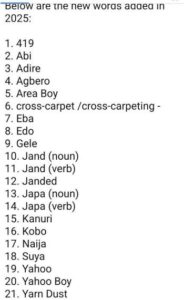
Recently, the Oxford English Dictionary (OED) officially absorbed over 20 Nigerian words and expressions, cementing the global cultural ascendancy of Africa’s most populous nation.
The December 2025 update, featuring more than 500 new entries, underscores a deliberate editorial shift toward “global Englishes.” Alongside additions from Maltese, Japanese, and South Korean English, a significant portion of the new lexicon hails from West Africa, with Nigerian Pidgin and local slang taking center stage.
“It reflects the growing, undeniable influence of these varieties of English on global communication,” an OED spokesperson noted.
The new entries are a snapshot of Nigerian daily life and wit:
“Abeg” and “Biko” (from the Igbo language) are now officially recognized interjections for “please,” capable of conveying everything from polite request to exasperated emphasis.
Culinary staples “amala” (a dough made from yam flour) and “moi moi** (a savory bean pudding) have made the leap from local delicacies to dictionary entries.
The term “Ghana Must Go” the ubiquitous checked plastic bag, is now defined with its full historical weight, tracing back to the 1983 expulsion of migrants from Nigeria.
Even the colloquial “nyash,” referring to a person’s buttocks, has found its place, highlighting the dictionary’s embrace of informal, street-level language.
This lexical recognition is not an isolated event but the culmination of a years-long Nigerian soft power offensive. The global domination of Afrobeats, the viral spread of Nigerian cinema (Nollywood), and the magnetic appeal of its internet-savvy youth have all served as delivery vehicles for the language.
“What we are witnessing is the formal acknowledgment of a cultural tide that has already swept across social media, music charts, and film streams,” said Dr. Kemi Adetiba, a linguist at the University of Lagos. “These words carry entire contexts, humor, history, social nuance, that are now being shared and understood worldwide.”
The update signifies more than novelty; it represents a democratization of English itself. The language, once shaped primarily by its Anglo-American custodians, is being vigorously remixed and expanded by its millions of new speakers, who are not just using English but actively reinventing it.
For Nigerians both at home and in the diaspora, the inclusion is a point of pride and validation. Their everyday expressions, born in markets, family kitchens, and roadside conversations, now share a page with the words of Shakespeare.